





By VFC PestMan | 30-08-2026
An insect light trap lamp may still emit blue light even though the amount of UV-A used to attract flies and other flying insects has significantly decreased. Visual observation alone is therefore insufficient to evaluate device performance. Measuring UV-A intensity under consistent conditions and comparing the results with baseline data and the manufacturer’s instructions helps businesses determine which lamps still meet requirements, which are declining and when replacement is needed before insect-monitoring capability is affected.
1. Why can a lamp still be illuminated while its ability to attract insects has decreased?

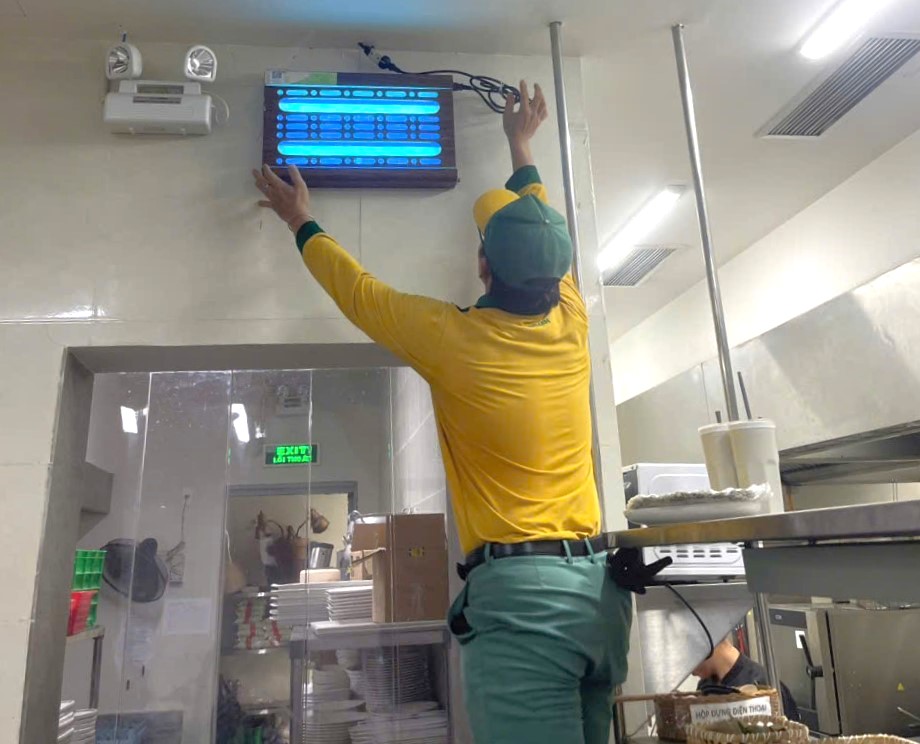
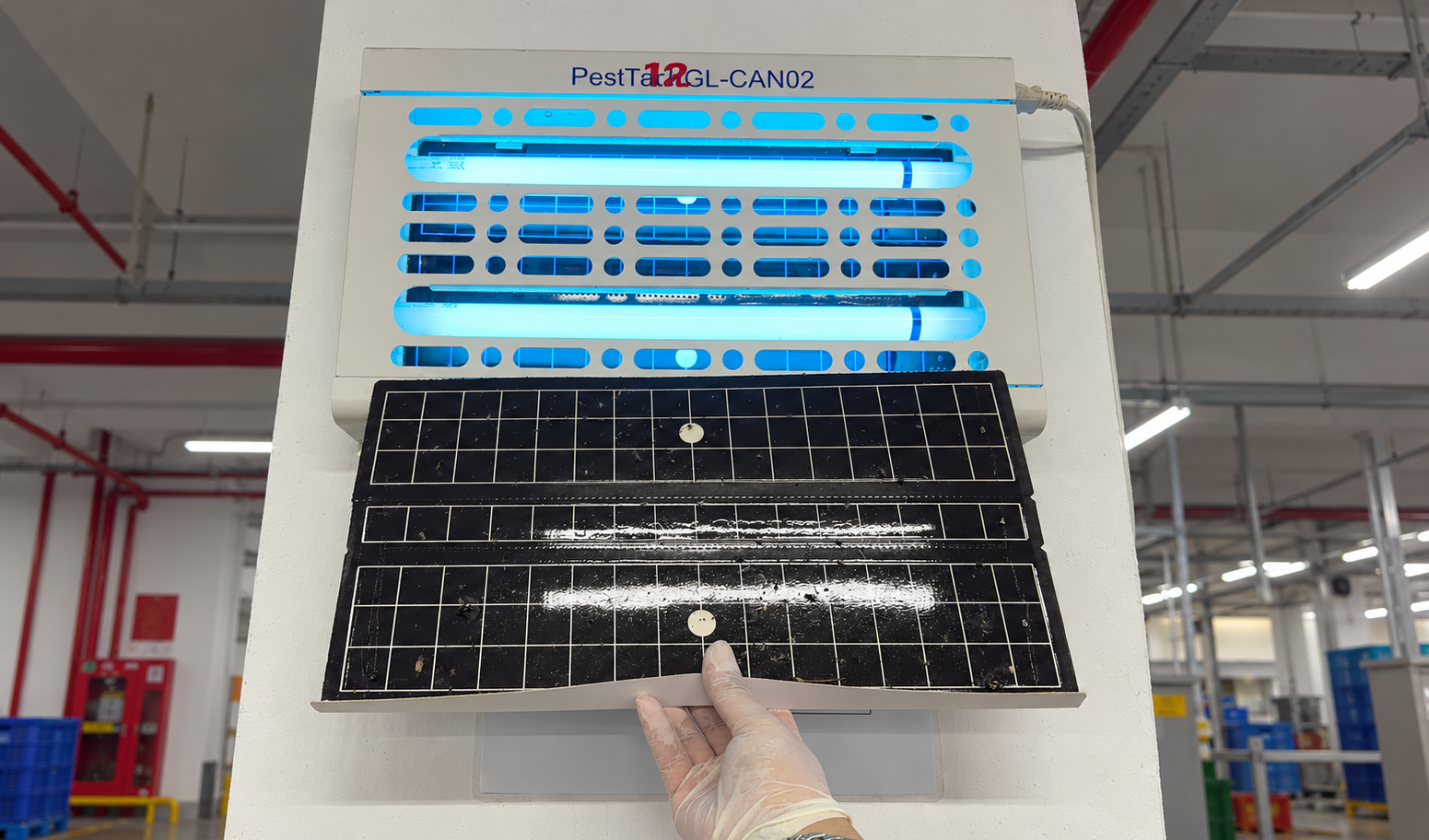
Insect light traps use ultraviolet A radiation, commonly referred to as UV-A, to create a light signal that attracts many species of flying insects. The human eye mainly sees the blue or violet visible light emitted by the lamp, while the UV-A component responsible for attraction cannot be observed directly. For systems using UV-A LEDs, businesses can further review how insect light traps combine UV-A with glue boards to attract and monitor flying insects.
During use, the light-emitting materials and components of the lamp gradually age. UV-A output may decline before there is any noticeable change in visible brightness. Therefore, a lamp that has not failed, is not flickering and still emits blue light may already have passed its period of highest effectiveness.
Dust, oil, shatter-resistant coatings, shields, protective grids and reflective surfaces also affect the amount of UV-A emitted from the device. In F&B factories, oil vapour or powder dust may accumulate on lamps and reflectors. Performance declines when the light source is obstructed even if the lamp has not yet reached its scheduled replacement date. Therefore, ILTs should be managed as part of an overall insect-control programme in food factories, together with sanitation, door management, entry points, drainage and monitoring.
Natural light and surrounding lighting also create visual competition. The same UV-A lamp may perform effectively in a dark corridor but be less prominent when installed near glass doors, dock doors or strong light sources. Device evaluation needs to consider the lamp, installation location and ambient lighting together.
2. What decisions does UV-A intensity measurement help businesses make?
Measuring UV-A intensity provides evidence of the lamp’s emission level at the time of inspection. The data help technicians distinguish lamp degradation from other causes such as incorrect placement, open doors, full glue boards, dirty equipment or changes in insect sources.
Measurement results also support condition-based lamp replacement rather than decisions based solely on visual judgement. Lamps with readings within the operating range specified in the guidance may continue to be used; lamps approaching the limit can be scheduled for replacement; and lamps below the threshold need to be replaced and rechecked after installation.
For F&B factories, pharmaceutical facilities, raw material warehouses and facilities with stringent assessment requirements, measurement records help demonstrate that monitoring devices are maintained on a clear basis. Auditors can see the measurement date, device code, lamp type, lamp age, results and corrective actions instead of only a periodic replacement schedule. UV-A records should form part of a broader system that includes monitoring-point data, insect density, trends over time and corrective actions after each inspection cycle.
UV-A measurement also supports installation-location selection. Technicians can assess background UV-A from natural light or other light sources and then select areas with lower competition. Correctly positioned devices can provide better attraction without requiring higher device power.
3. When should the UV-A intensity of insect light traps be measured?

3.1. When installing a device or replacing a lamp
The first measurement establishes a reference value for each device. The result needs to be recorded together with the lamp type, wattage, installation date, measuring distance, measuring instrument and lighting conditions. Subsequent measurements should use the same method to track degradation over time.
Measurement after lamp replacement also helps detect a new lamp with incorrect specifications, improper installation, power-supply problems or an obstructed reflector. If the business only records that the lamp was replaced, it still does not know whether the device is actually producing the expected output after maintenance.
3.2. According to a risk-based inspection schedule
Facilities should include UV-A intensity measurement in the maintenance schedule instead of waiting for lamps to go out. Areas with exposed products, packaging zones, sensitive raw material warehouses or locations with a history of high insect numbers require more frequent monitoring than offices and low-risk corridors.
Factories may choose quarterly inspections, inspections before periods of increased insect activity or inspections during major reviews, depending on risk assessment and IPM programme requirements. The interval needs to be sufficient to detect a declining trend before the lamp passes its service limit. The manufacturer’s guidance remains the primary reference for each lamp type.
3.3. When taking over a system with an unclear maintenance history
A device that is still illuminated does not indicate how long the lamp has been operating. When taking over a new factory, changing service providers or adding older equipment to the device map, technicians need to measure UV-A and check the lamp code, shatter-resistant coating, manufacturing date and component condition.
If the lamp-replacement history cannot be confirmed, measurement results help classify which devices need immediate lamp replacement and which can continue to be monitored. This approach prevents degraded lamps from being retained simply because they appear intact, while also avoiding unnecessary blanket replacement without a clear basis.
3.4. When the number of insects captured decreases abnormally
A lower number of insects on a glue board may result from lower insect density, but it may also indicate weak UV-A output, an obstructed location or increased competing light. Technicians need to cross-check measurement results with trap data, on-site evidence and operational changes.
If insects are still present in the area but the number on the glue board drops noticeably, the lamp and device need to be inspected promptly. This analysis helps prevent the incorrect conclusion that the programme has improved when the monitoring tool is actually losing its attraction capability. Conversely, if capture numbers increase, correctly identifying the fly group and comparing it with the source of occurrence in each area is more useful than looking only at the total number of insects on the glue board.
3.5. After changes in location or lighting conditions
New glass doors, new factory lighting, illuminated signs, partitions or changes in door-opening hours can alter background-light levels. The device may still operate normally, but its contrast with the surrounding environment may decrease. Measuring background UV-A and device output helps reassess the installation location.
After relocating an insect light trap, businesses should record the new distance to doors, product areas, light sources and insect movement routes. The new data then become the reference point for the new location, avoiding direct comparison with measurements taken under previous conditions.
3.6. Before an audit or peak production period
Measuring immediately before an audit should not be the only objective. Inspection should be carried out early enough to allow time for lamp replacement, device repair, position adjustment and result confirmation. Records completed before the audit help the quality team review the programme more proactively. For food factories applying FSSC 22000 or BRCGS, ILT data should be managed within a broader framework covering risk zoning, data traceability and evidence of corrective actions..
Before raw-material season, periods of increased production capacity or times of high flying-insect activity, businesses should also confirm system performance. A lamp approaching the end of its service life can be replaced before the peak period to reduce the risk of disruption and avoid emergency corrective action.
4. Which factors need to be controlled when measuring UV-A intensity correctly?
4.1. Use a measuring instrument suitable for the light-source type
The UV-A meter must have a spectral range and calibration method suitable for the lamp being tested. Some specialised meters are designed for fluorescent insect-light-trap lamps and may not be suitable for UV-A LED modules. Technicians need to check the instrument’s intended range of use before collecting data.
Conventional light meters measure visible light and do not accurately reflect UV-A intensity. Smartphones also cannot replace specialised instruments. Data from the wrong type of sensor may appear precise but lead to poorly supported lamp-replacement decisions.
4.2. Measure background light before measuring the device
Sunlight and other UV-A sources can affect the result. Procedures for many specialised meters require measuring the background level with the insect light trap switched off, saving this value and then measuring the UV-A source while the device is operating. The meter will either exclude or allow the user to compensate for environmental influence.
Lighting conditions change throughout the day, particularly near glass doors and dock doors. Comparative measurements should be taken at similar times of day. When evaluating an installation location, technicians may measure at several times to understand actual light competition.
4.3. Maintain the correct measuring distance and angle
Measured intensity decreases rapidly as distance increases, so changing the position of the meter makes results less comparable. The measuring distance needs to follow the meter instructions and take into account the total lamp wattage within the device. The sensor should be directed toward the centre of the light source at the specified angle.
Each device code should have a repeatable measurement method that specifies distance, height and sensor direction. Technicians should avoid taking one measurement close to the device and another farther away and then comparing them directly. Photographs of the measuring position or floor markers can help maintain consistency across inspection cycles.
4.4. Clean and inspect the device before reaching a conclusion
Dirt on the lamp, reflector or shield can reduce the reading. Before concluding that the lamp is no longer effective, technicians need to disconnect power according to safety procedures, clean the device using an appropriate method and recheck it after full reassembly.
A full or warped glue board, or one that obstructs the light source, can also affect insect capture even when the lamp reading remains acceptable. The starter, ballast, power supply and electrical contacts need to be inspected when a lamp flickers or starts slowly. Insect light trap performance is the result of the entire system.
4.5. Record measurements using consistent units and conditions
Specialised meters may display colour-coded zones such as acceptable, near-limit and replacement required, while quantitative meters may display W/m² or µW/cm². Businesses need to use the same instrument, interpretation method and criteria across inspection cycles for the data to remain meaningful.
A single figure has limited value without the measuring distance, lamp type, operating time and background level. The form should record the device code, lamp code, installation date, measurement date, operating hours if available, result, person taking the measurement and action taken. These data create a trend line for each device.
5. Is there a universal UV-A threshold for all insect light traps?
There is no single value suitable for every lamp type, wattage, device and measuring distance. Measured intensity varies according to total wattage, reflector design, shatter-resistant coating, lamp age, distance, measuring angle and sensor sensitivity range.
The appropriate threshold needs to come from the instructions provided by the lamp, device and meter manufacturers. For meters using colour-coded zones, green generally indicates an acceptable level, yellow indicates output approaching the limit and red indicates replacement is required. The exact meaning needs to be interpreted according to the documentation for the specific device.
When using a quantitative meter, businesses should establish a baseline using a new lamp of the correct type under standardised conditions. Subsequent measurements are compared with this baseline and limits approved by the manufacturer or internal programme. Copying a threshold from a different lamp model may lead to an incorrect assessment.
Lamp-replacement criteria should combine UV-A intensity, lamp age, physical condition, insect-capture history and the risk level of the area. A lamp approaching the limit in an exposed-product area may be prioritised for earlier replacement than a lamp at the same level in a less sensitive corridor.
You may also be interested in: Ensystex LED insect light traps - An effective and safe flying-insect control solution for different environments
6. When should insect light trap lamps be replaced?

6.1. When measurement results fall below the acceptable limit
This is the most direct basis for replacement. When the meter indicates the replacement zone or the reading is below the approved criterion, the lamp needs to be replaced and the result remeasured for confirmation. If a new lamp still produces a low result, technicians need to continue checking the power supply, reflector, installation position and component compatibility.
For results close to the limit, businesses can plan replacement before the peak period or at the next service visit. High-risk areas require a shorter response time. The decision and its reason need to be recorded in the report to support traceability.
6.2. When fluorescent lamps reach the recommended replacement cycle
Many manufacturers recommend replacing fluorescent UV-A lamps at least every 12 months, often before warmer weather or periods of high insect activity. The one-year interval is a common guideline because UV-A output can decline significantly even while the lamp remains illuminated.
The actual replacement cycle may be shorter in areas with continuous operation, unfavourable temperatures, heavy oil or dust accumulation, strong sunlight or stringent control requirements. Measuring UV-A during the year helps identify lamps that deteriorate faster than the scheduled interval. A 12-month schedule does not replace condition monitoring.
6.3. When UV-A LEDs reach the manufacturer-specified service life
UV-A LED modules generally have a longer service life than fluorescent lamps, but the duration varies between systems. Some models are designed for replacement after several years rather than annually. Businesses need to manage them according to the correct LED code and the insect-light-trap manufacturer’s guidance.
The 12-month fluorescent-lamp replacement rule should not be applied automatically to LEDs. Conversely, a “long-life LED” label is not sufficient reason to omit measurement and maintenance. Heat, power supply, dust and operating conditions can affect actual output.
6.4. When a lamp shows physical or operational abnormalities
Darkened lamp ends, cracks, peeling coatings, flickering, slow start-up or uneven illumination are signs that require attention. A broken lamp or damaged shatter-resistant coating creates a physical hazard, particularly in F&B factories and areas with exposed products.
Technicians need to use the correct wattage, dimensions, wavelength, lamp-base standard and shatter-resistance specification for the device. A lamp may still illuminate but, if it is the wrong type, it can reduce attraction performance or cause electrical problems. Replacement components should be included in the approved parts list.
6.5. When usage history is unknown and results are unreliable
Devices without a recorded lamp-replacement date, with unreadable lamp codes or incomplete maintenance records need to be assessed immediately. If the meter is incompatible or the readings fluctuate significantly, replacing the lamp with the correct specification and re-establishing baseline data is often a clearer management approach.
After replacement, the installation-date label needs to be attached to the device or updated in the management system. Each lamp should be linked to the device code and location. This simple step helps avoid an unknown lamp age at the next inspection cycle.
7. Should all lamps in the same device be replaced at the same time?
For devices using multiple lamps of the same type installed at the same time, replacing them together generally helps maintain balanced output and simplifies the maintenance schedule. If only one lamp is replaced, the device may contain one new source and one degraded source, making overall data more difficult to interpret.
If one lamp fails early because of an isolated fault, the cause needs to be investigated before a replacement decision is made. Technicians should inspect the power supply, starter, ballast and electrical contacts to prevent the new lamp from experiencing the same issue. For systems using starters, many instructions recommend replacing the starter at the same time as the lamp.
Businesses should consider risk level, cost and traceability. Devices in sensitive areas are generally better suited to coordinated replacement schedules. Modular LED devices may follow different procedures, so whether individual modules or the entire assembly should be replaced needs to follow the manufacturer’s design.
Used fluorescent lamps may contain components that require collection and disposal in accordance with applicable requirements. Technicians should avoid disposing of them with general waste or breaking them during removal. The lamp-replacement area needs to be protected to prevent risks from fragments and contamination.
8. Is the number of insects on the glue board sufficient to assess a UV-A lamp?

Capture numbers are important data, but they are influenced by insect density, season, open doors, sanitation, location and the period for which the glue board remains in place. A glue board with fewer insects may indicate an improved environment or reduced device attraction. Additional data are needed to distinguish between these two situations.
If the number of insects captured decreases together with a reduction in on-site evidence, the trend may be a positive signal. If personnel still observe many flies or detect insects near products while the trap captures few, technicians need to inspect UV-A output, the glue board, device location and device operation.
Conversely, an increase in captures does not by itself prove that the lamp is performing well. A new insect source, an open or poorly sealed door, or an incoming material lot carrying insects may increase capture numbers even while UV-A output is declining. Trap data need to be analysed together with on-site conditions and operations.
Therefore, UV-A intensity measurement and glue-board analysis serve two different roles. Measurement evaluates the emission capability of the light source, while the glue board indicates insect activity at the monitoring point. Combining the two types of data helps businesses reach a more reliable conclusion.
9. Which common errors make UV-A measurement results unreliable?
The first common error is using an instrument that is not suitable for the lamp’s spectral range, particularly when a meter designed for fluorescent lamps is used to assess LEDs. Another error is ignoring background UV-A, measuring near glass doors or changing the measurement time between inspection cycles.
Inconsistent measuring distances and angles can also cause substantial variation in the data. Moving the sensor closer produces a higher reading even when the lamp has not changed. Businesses need to standardise the measuring position according to total wattage and the meter instructions.
Measuring a dirty device and then concluding that the lamp has reached the end of its life may lead to premature replacement. Conversely, cleaning the lamp while overlooking the reflector, shield and power supply also results in an incomplete diagnosis. The system needs to be inspected both before and after corrective action.
Another error is using the same threshold for every device model. A 15 W device, a 30 W device and a multi-lamp system produce different outputs; LEDs and fluorescent lamps also have different characteristics. Each device group needs appropriate criteria, methods and forms.
10. What information should UV-A lamp management records contain?
The insect light trap map needs to show the device code, location, device type and risk zone. Lamp records should include the manufacturer, product code, wattage, fluorescent or LED type, shatter-resistance requirement, installation date and scheduled reassessment date.
Measurement records need to include the date and time, meter used, calibration or functional-check status, background UV-A level, measuring distance, angle and result. When the instrument displays colour-coded zones, technicians need to record the zone and corresponding action. When the instrument displays a numerical value, the unit of measurement must be recorded in full.
Post-measurement actions may include cleaning, remeasurement, lamp replacement, starter replacement, power-supply repair or device relocation. Each action should have a responsible person and completion deadline. Confirmation results after corrective action provide evidence for closing the issue.
Insect-capture data, glue-board replacement dates and species-specific trends should be linked with UV-A records. When capture numbers change, the quality team can review both the light-source condition and environmental conditions at the same time. This provides a foundation for more reliable trend analysis. For systems with many devices, linking ILT codes, inspection schedules, capture data and corrective actions within a centralised data-management system helps QA retrieve information more quickly when analysis or audit support is required.
11. How does VFC PestMan support insect light trap management?

VFC PestMan surveys installation locations, insect sources, competing light and the sensitivity level of each area. Devices are included in the monitoring map with identification codes, lamp types and appropriate maintenance schedules. This zoning approach helps factories prioritise resources for high-risk points.
If multiple ILT points repeatedly record abnormalities, the issue should be assessed more broadly by reviewing attractant sources, entry routes, critical areas and the overall layout of the facility’s monitoring system.
Technicians inspect the condition of lamps, glue boards, reflectors, power supplies and maintenance accessibility. When a compatible meter is used, UV-A results are recorded under standardised conditions and compared with the device guidance. Lamps requiring replacement are identified based on data rather than visual judgement.
After each inspection cycle, the business receives a report on the number and species of insects captured, device condition, inspection results and recommendations. The quality team can identify which points are operating stably, which require lamp replacement and which locations need adjustment because of environmental changes.
VFC PestMan also coordinates with production, warehouse, maintenance and sanitation teams to investigate changes in trap data. Insect light traps are managed as monitoring tools within the IPM programme, linked with entry points, sanitation, sources of occurrence and corrective actions. When selecting a provider to manage ILTs and the pest-control programme, businesses should evaluate IPM capability, data transparency and the ability to support investigations and audits when abnormalities arise.
12. Frequently asked questions
Does a UV-A lamp need to be replaced even if it is still illuminated?
It may need to be replaced when UV-A output has fallen below the limit even though visible blue light remains. The human eye cannot assess the UV-A component used to attract insects. Businesses should base the decision on lamp age, measurement results and the manufacturer’s guidance.
How often should fluorescent UV-A lamps be replaced?
Many manufacturers recommend replacement at least every 12 months, usually before periods of increased insect activity. The cycle may be shorter in high-risk areas or when measurements show that a lamp is degrading earlier. The replacement schedule needs to be linked to the specific lamp type and operating conditions.
Do UV-A LED lamps need to be replaced annually?
UV-A LEDs generally have a longer service cycle than fluorescent lamps, and some models are designed for several years of use. Replacement timing needs to follow the guidance of the relevant manufacturer, measurement results from a compatible instrument and the actual condition of the module.
Can a lux meter be used to check a UV-A lamp?
A lux meter measures visible light, while UV-A lies in a different spectral range. Lux readings do not accurately reflect the lamp’s UV-A output. Technicians need to use a UV-A meter with a spectral range suitable for the light source.
Why is background environmental UV-A measured?
Sunlight and surrounding UV-A sources can affect measurement results or reduce the contrast of the insect light trap. Measuring the background level helps separate environmental influence from device output and supports better installation-location selection.
What if insect captures remain low after a new lamp is installed?
Technicians need to check the installation location, glue board, entry points, competing light and actual insect density. A new lamp only addresses the attraction source; capture performance also depends on device design and the surrounding environment.
Should lamps be replaced immediately before an audit?
Businesses should inspect them early enough to allow time for corrective action and confirmation of effectiveness. Replacing lamps immediately before an audit without supporting inspection data does not demonstrate continuous programme management. Trend records and timely actions provide greater value than a one-time blanket replacement.
UV-A intensity measurement needs to be carried out when installing or replacing lamps, according to a risk-based schedule, when insect-capture data change, after relocation and before important operating periods. Measurements must use compatible instruments and control background light, distance and measuring angle so that results remain comparable.
Fluorescent lamps are generally recommended for replacement at least every 12 months, while UV-A LEDs need to follow the service life specified for each system. Measurement results, lamp age, device condition and glue-board data need to be reviewed together. VFC PestMan supports businesses in standardising inspection, lamp replacement and data analysis so that insect light traps continue to perform their intended role within the IPM programme.


Các loại bẫy và thiết bị giám sát dịch hại trong nhà máy
Bẫy và thiết bị giám sát là một phần quan trọng trong chương trình kiểm…
Pheromone traps: An insect monitoring solution for pest control
Pheromone traps are applied in pest control due to their ability to attract...
Related news


Ready to eliminate audit risks and proactively protect customer experience & brand reputation?





Dear Valued Visitor,
To protect our clients' interests, all materials here are copyrighted and may not be reproduced without permission.
We appreciate your cooperation. Should you need to use our content professionally, please contact us directly.