





By VFC PestMan | 19-08-2026
The AIB 2027 standards will officially apply to inspections at food and beverage manufacturing facilities from January 1, 2027. This is the latest AIB update, and F&B businesses should begin reviewing requirements related to actual site operations early, particularly their Integrated Pest Management (IPM) programmes.
In addition to procedures, personnel competence, management records and monitoring-device systems, facilities need to pay close attention to infrastructure conditions such as receiving and dispatch doors, structural gaps, drains, waste areas and the external perimeter. Early assessment gives businesses enough time to address outstanding issues before the updated standards take effect.
1. What should businesses pay attention to in AIB 2027?
AIB International officially released the 2027 update in July 2026 and provided the remainder of the year for businesses to review requirements, train personnel, update procedures and prepare for implementation from January 1, 2027. From that date, facilities will be inspected against the applicable 2027 standards rather than the versions used in 2026.
AIB 2027 continues to maintain five core categories:
- Operational methods and personnel practices
- Maintenance for food safety
- Cleaning practices
- Integrated pest management
- Adequacy of prerequisite and food safety programs
Each category has a maximum score of 200 points, resulting in a maximum total score of 1,000 points for the inspection. Businesses that want to learn more about AIB and how these five categories are scored can refer to What is the AIB standard? The importance of AIB in the Food and Beverage (F&B) industry
In this article, VFC PestMan focuses on the changes introduced in the AIB 2027 update that directly affect pest management programmes.
According to AIB International, the 2027 update retains the core GMP standards but refines and expands them across six areas, including standardised wording and terminology, restructured sections, adjusted and expanded inspection criteria, and new provisions designed to reflect current technology and operating practices.
For pest management, three areas deserve particular attention in AIB 2027: electronic IPM monitoring devices, alternative pest-detection methods, and the escalation mechanism for repeated Serious findings beginning in 2028.
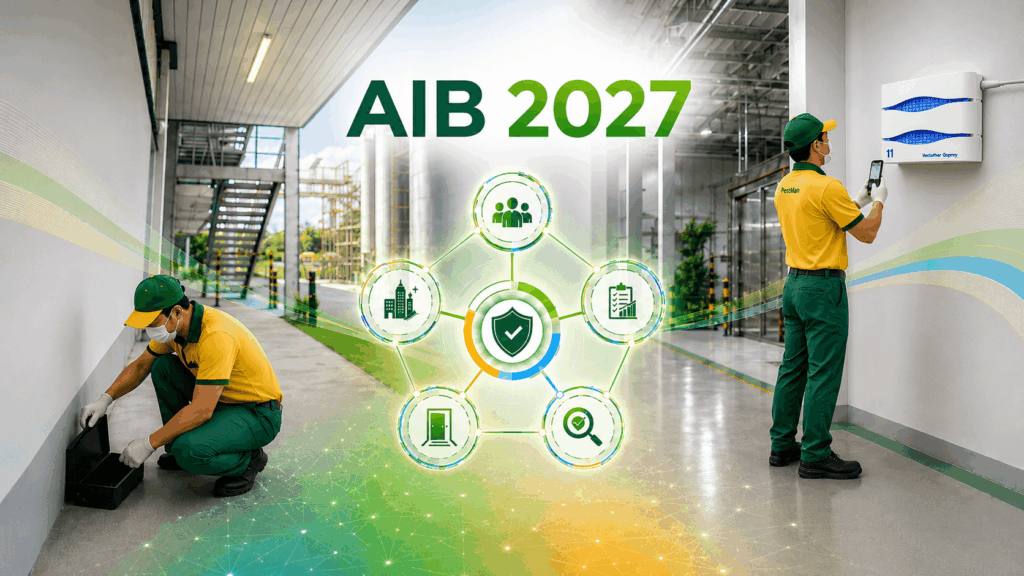
1.1. AIB 2027 adds requirements for electronic IPM monitoring devices
One notable change in AIB 2027 is that electronic IPM monitoring devices are now addressed as a separate group of requirements. According to AIB International, this change reflects the growing use of devices with Bluetooth, Wi-Fi and other forms of remote monitoring in pest management programmes.
When electronic monitoring devices are used, businesses need a written programme covering monitoring, maintenance and data review. The procedure also needs to define how pest alerts are handled and what actions are taken when devices lose power, batteries are depleted, connectivity is lost or technical failures occur.
A key point of this requirement is that device data need to be linked to actual action. Detection of pest activity by a sensor or monitoring device is only the first step; the facility also needs to define who receives the alert, the required response time and what action is taken afterwards.
Businesses using technology in their pest management programmes should therefore review their entire device-management process before AIB 2027 takes effect. Electronic systems need to support early detection and rapid response rather than simply creating an additional layer of data that is not used effectively.
You may also be interested in: Data-driven pest management: Exploring real-time analytics through the PestMan Dashboard and App
1.2. AIB 2027 expands to alternative pest-detection methods
AIB 2027 adds requirements for alternative pest-detection methods. One example stated directly in the standard is the use of trained detection dogs to support rodent detection.
If animals are used for pest-detection activities, AIB 2027 requires a written procedure and implementation in a manner that does not create contamination risks for raw materials, work-in-process products, finished products or production areas.
AIB 2027 does not require every business to adopt these new methods. The important point is that when a new technology or method is introduced into an IPM programme, the business needs a defined basis for managing, controlling and evaluating its effectiveness.
1.3. AIB 2027 clarifies risk-rating criteria
The AIB 2027 update refines the criteria describing each risk-rating level, making the severity of findings more transparent and consistent.
| Risk assessment | Description | Score |
| No Issues Observed | No hazard is present | 200 |
| Minor Issues Noted | There is no contamination risk and the issue does not result in programme failure. This rating may be applied to one main principle where an isolated finding can be reasonably explained and does not create a potential risk during the inspection. Risk-control programmes have been fully established and implemented | 180-195 |
| Improvement Needed | A potential hazard exists, part of a programme is deficient, or a food safety finding does not conform to the main principles defined in the standard. If not corrected or addressed, these hazards, deficiencies or findings may reduce the effectiveness of the food safety programme and increase contamination risk | 160-175 |
| Serious | A significant contamination risk exists, there is a serious programme deficiency, or programme implementation is ineffective or incomplete; if not addressed, this may lead to programme failure | 140-155 |
| Unsatisfactory | An immediate food safety hazard exists, the programme has failed, there is regulatory non-compliance and/or trends indicate inadequate or ineffective implementation and execution of prerequisite and food safety programmes | ≤135 |
For pest management, this approach means that businesses need to assess risk more deeply based on where the finding occurs. The same type of insect finding can have a very different level of severity depending on whether it occurs in the external grounds or directly inside a production area.
Therefore, when preparing for AIB 2027, pest-management data should answer at least four questions:
- Where was the pest activity detected?
- What level of risk does it pose to the product?
- What is the likely source of the issue?
- What action did the facility take after the finding?
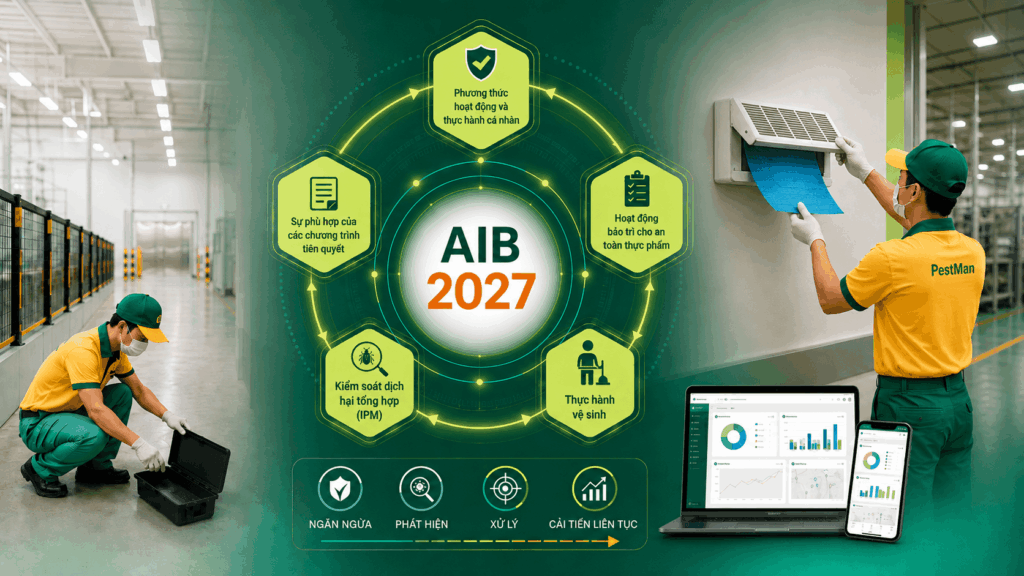
This information needs to be reflected in pest control reports in a way that allows QA/QC teams to understand pest activity levels, trends, abnormal areas and the preventive or corrective actions taken.
1.4. From 2028, repeated Serious findings will be escalated in severity
One change with direct impact on inspections after AIB 2027 is the escalation mechanism for repeated Serious findings. This mechanism will apply from January 1, 2028 to repeated findings under the same requirement as the most recent scored inspection.
In simple terms, if a finding is rated Serious in 2027 and receives 155 points, but the issue recurs in 2028, the score may be reduced further to 140 points under the severity-escalation mechanism.
Importantly, the finding in the following year does not have to be exactly the same as the finding from the previous inspection. AIB International states that if the new finding falls under the same requirement and still meets the Serious rating criteria, the severity-escalation mechanism may be triggered.
For pest management programmes, this places greater emphasis on addressing underlying causes. An area with recurring rodent activity, a structural gap repeatedly recorded but not repaired, or a sanitation issue that persists across multiple inspections needs to be followed through until effective resolution has been confirmed. Issues that recur across multiple inspections are also a signal that the business needs to reassess the pest management programme, identify the root cause and confirm effectiveness after corrective action.
Businesses preparing for AIB 2027 should therefore begin reviewing issues that have recurred in previous inspections. This helps reduce the risk that an unresolved weakness will continue to affect inspection results in 2028.
2. AIB 2027 continues to focus on actual site conditions
An important feature of AIB is the distinction between Inspection and Audit. An inspection focuses on physical conditions and what is actually happening at the facility at a specific point in time, while an audit reviews programmes, records and data over time. AIB combines both approaches, but the primary focus remains on actual site inspection.
This approach continues under AIB 2027. For pest management, complete documentation alone cannot demonstrate that a programme is operating effectively if actual site conditions show otherwise. A gap between documentation and actual site conditions is also one of the signs that a pest management programme is not operating effectively in practice.
For example, a business may have complete service contracts, trap maps and inspection reports, while a gap at a receiving or dispatch door remains unresolved or the same area continues to show signs of pest activity. These site findings reflect how effectively the programme is actually being implemented.
AIB 2027 also retains the principle that observations recorded in the first four categories directly affect the assessment of Adequacy of Prerequisite and Food Safety Programs. In other words, actual facility conditions provide evidence of whether programmes designed on paper are operating effectively in practice.
Preparation for AIB 2027 should therefore begin with actual site conditions and day-to-day operations, followed by comparison with records, data and management procedures.
3. What should businesses prepare for AIB 2027?
AIB International recommends that businesses first review the changes relevant to their type of facility, then assess current programmes, identify gaps and update procedures, records, responsibilities and training where necessary. Implementation needs to be based on risk, actual operations and the applicable standard for each facility.
For pest management programmes, F&B businesses should focus on the following areas.
3.1. Reassess the entire facility
Facility assessment is an important step in determining whether the current IPM programme remains appropriate for actual operating conditions. Under the standard, trained IPM personnel need to conduct a complete facility assessment at least once each year.
The assessment needs to cover production areas, warehouses, raw material receiving, support areas, waste zones, drainage systems and external grounds. The objective is not only to identify where pests are currently present, but also to identify conditions that may provide food, water, harbourage or entry routes.
Changes to the facility also need to be incorporated into the assessment. Warehouse expansion, installation of new production lines, changes in material flow or relocation of waste areas can all create new risk points that may not be covered by the current pest management programme.
When preparing for AIB 2027, businesses should use facility assessment as the basis for identifying gaps between the existing IPM system and actual operating conditions.
3.2. Review personnel competence and service scope
Personnel responsible for pest management need training appropriate to their assigned duties. Training includes knowledge of pest biology, including lifecycle, behaviour, food sources, harbourage and conditions that support the development of each species.
Alongside personnel competence, businesses also need to review the service scope. The programme must clearly define service areas, inspection frequency, methods, equipment, approved pesticides, responsibilities of each party and the required response when pest activity changes. Inspection frequency should also be determined according to risk levels, monitoring data and actual changes in each area rather than applying the same cycle across the entire facility.
One important consideration is establishing pest activity thresholds. When activity exceeds the threshold, businesses need an escalation procedure, such as increasing inspection frequency, expanding the inspection scope, identifying the cause or implementing corrective action.
Preparing for AIB 2027 therefore goes beyond checking whether the service provider has completed the required number of visits. The business needs to assess whether the programme responds appropriately to the actual level of risk. When evaluating a PCO, businesses should consider its IPM capability, data transparency, audit support and ability to respond when risk levels change.
3.3. Review pesticide records and pesticide use
Pesticide records, application records and chemical-management activities need to be reviewed before AIB 2027 takes effect.
Businesses need to be able to trace the pesticide used, application location, date and time, person responsible and treatment purpose. Storage and use also need to be controlled to avoid creating risks to raw materials, packaging, food-contact surfaces or finished products.
In particular, use of pesticides in a manner inconsistent with label directions is listed by AIB among the conditions that may result in an Unsatisfactory rating.
This shows that pesticide management needs to be treated as part of the food safety system rather than being delegated entirely to the PCO or external contractor.
3.4. Compare device maps with the actual monitoring system
Trap systems and monitoring devices need to accurately reflect actual facility conditions. Businesses should verify each location on the device map against the actual device and update the map whenever the number, location or type of device changes.
AIB includes requirements for several device categories, including exterior rodent-monitoring devices, interior rodent-control devices, insect light traps and pheromone-based devices. AIB 2027 further expands this system by addressing electronic monitoring devices as a separate management requirement.
Facilities therefore need to ensure that device maps, device IDs, inspection records and actual field conditions are consistent with one another. A device that has been relocated but not updated on the map, or a newly emerging risk area that has not been assigned a monitoring point, both need to be reviewed.
3.5. Use trend analysis to detect risks early
Pest-management data need to be reviewed over time through trend analysis. The objective is to determine which areas are experiencing increased pest activity, which species appear repeatedly and whether the actions implemented have actually produced improvement.
For example, if a group of insect light traps repeatedly records increasing insect captures, the business needs to review doors, light sources, sanitation conditions, waste areas or the surrounding environment. If the same location repeatedly shows signs of rodent activity, the facility needs to continue investigating entry routes, food sources and harbourage.
Trend analysis only creates value when the data lead to action. This is also an important element in preparing for AIB 2027, because the IPM programme needs to demonstrate the ability to detect issues, respond and reassess effectiveness after treatment.
4. Which infrastructure conditions should be reviewed before AIB 2027?
Pest management under AIB 2027 is not demonstrated only through trap systems or IPM documentation. Pest-prevention requirements also appear in storage, maintenance, sanitation, grounds management and other operating conditions.
In storage areas, facilities must maintain clearance from walls and floors to support cleaning and IPM activities. Materials susceptible to insect infestation that are stored for four weeks or longer must be inspected at least once every four weeks.
Pallets stored outdoors must also be inspected for signs of insects, mould or contamination before being brought into the facility. Waste and refuse need to be managed to reduce the risk of attracting pests.
In external areas, trees, dense shrubs and tall grass must not create pest harbourage or access routes to the facility. Internal roads, yards and parking areas need to minimise standing water; drainage systems must be properly maintained; and waste containers need to be closed or covered to reduce attraction and harbourage.
For facility structures, AIB 2027 requires protective measures against birds, rodents, insects and other pests. Doors, windows and other openings to the exterior must be sealed or protected so that openings are smaller than 1/4 inch, equivalent to approximately 6 mm. Openings required for ventilation need to be fitted with insect screens.
Floors, walls and drains also need to be maintained to minimise cracks, harbourage points and pest entry routes. This shows that preparation for AIB 2027 requires coordination among QA/QC, maintenance, sanitation, warehousing and operations rather than being left solely to the pest management provider.
5. Which pest findings may result in an Unsatisfactory rating?
AIB 2027 lists several examples of conditions that may lead to an Unsatisfactory rating within the pest management programme. Businesses need to pay particular attention to these findings because they indicate either a direct food safety hazard or a serious programme failure.
Cases include:
- insect activity in a location where product contamination may occur;
- live animals observed inside the building;
- animal droppings or gnaw marks found on raw materials or finished products;
- decomposing animal carcasses inside the facility;
- bird activity or nesting within production areas;
- bird droppings in areas containing product, raw materials or finished products;
- birds nesting or residing in warehouses;
- use of pesticides in a manner inconsistent with label directions.
AIB 2027 also continues to require that, for a facility to receive recognition, no category may score 135 points or below, and there must be no Unsatisfactory findings, even if the total score is 700 points or higher.
Businesses should therefore not assess pest risk solely by the number of individual pests detected. Location, contamination potential, level of pest activity and the programme’s response all need to be considered.
6. What should businesses prioritise before AIB 2027 takes effect?
The period before January 1, 2027 is the time for businesses to review the actual readiness of their IPM programmes. Rather than reviewing everything with equal priority, facilities should focus on issues most likely to affect inspection results or require significant time to correct.
For a pest control program, businesses should prioritize the following contents:
- Review AIB 2027 changes that directly affect the IPM programme, particularly if the facility uses electronic monitoring devices or new detection methods.
- Review issues that have recurred across multiple inspections, especially findings previously rated Serious or entry points that have not been fully corrected.
- Compare device maps, equipment, records and actual data to ensure that the management system reflects actual facility conditions.
- Analyse pest data over time to identify areas showing increasing risk at an early stage.
- Prioritise infrastructure issues that require time to correct, such as doors, structural gaps, drains, waste areas and external conditions.
To translate these requirements into practical action, businesses can refer to the process from site assessment and risk identification to monitoring-point setup, treatment and regular follow-up. The objective of the preparation period is therefore not simply to complete a checklist before the inspection. Businesses need to create evidence showing that risks have been identified, addressed and followed through until results are confirmed. This is also an important foundation for adapting to the continuous-improvement approach emphasised in AIB 2027.
7. How VFC PestMan supports businesses preparing IPM programmes for AIB 2027
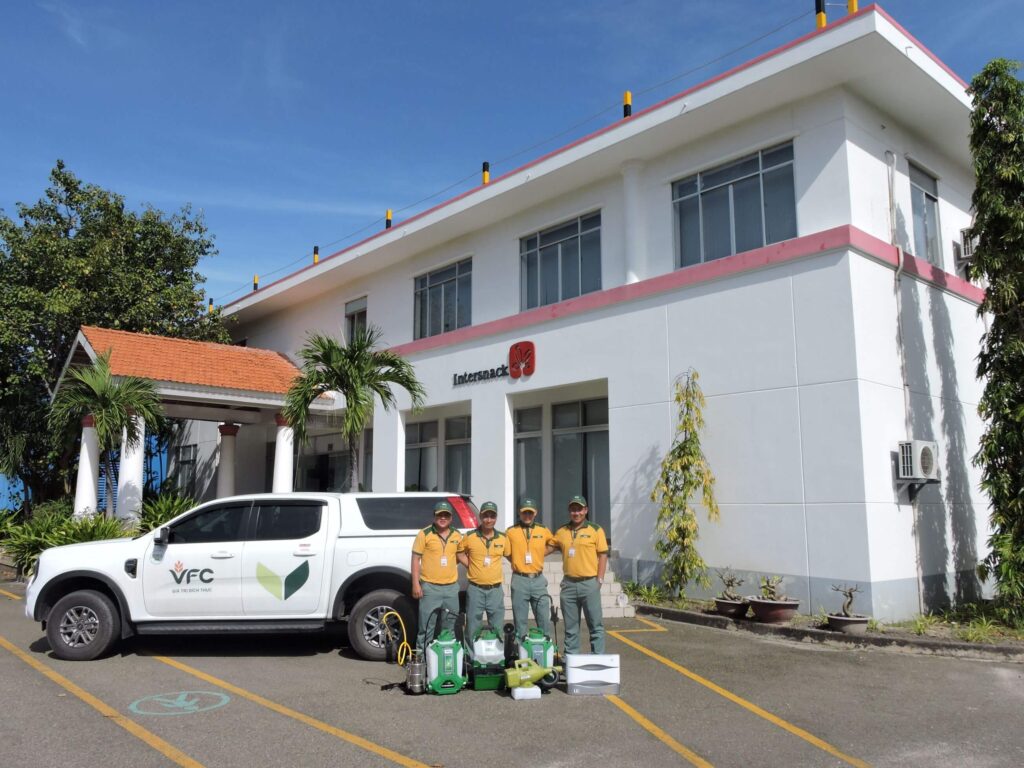
With more than 50 years of experience in pest management, VFC PestMan has supported many F&B businesses and corporations in developing and operating IPM programmes, including customers that have achieved the maximum score in the pest management category.
VFC PestMan develops these programmes based on facility operating conditions, target pests and the risk level of each area within the plant.
In addition to field control activities, pest data are monitored and analysed over time to identify areas showing abnormal activity or recurring issues. Infrastructure, sanitation and operational issues are also recorded so that the business has a basis for coordinating corrective action with the relevant departments.
VFC PestMan’s digital management system supports the storage of inspection data, site photographs, device information and pest-activity history. This allows QA/QC teams to retrieve data more efficiently, track trends and review programme effectiveness over time.
Overall, the updated AIB 2027 standards place emphasis on actual control capability rather than documentation alone. The transition period before the effective date is a valuable opportunity for F&B facilities to proactively close infrastructure gaps, standardise procedures for new monitoring technologies and fully address outstanding potential risks.
Early preparation not only helps businesses approach stringent inspections with greater confidence, but more importantly supports the establishment of a proactive, data-driven and continuously improving prevention system for long-term facility protection.


Dịch vụ kiểm soát côn trùng cho doanh nghiệp: Quy trình từ khảo sát đến giám sát định kỳ
Một chương trình kiểm soát côn trùng hiệu quả cần được xây dựng theo quy…

VFC PestMan – công ty diệt côn trùng cho doanh nghiệp
Doanh nghiệp cần xử lý côn trùng theo một hệ thống có khả năng kiểm…


Related news

Food Testing in 2026: Mandatory Testing Parameters and Compliance Procedures for Food Businesses
Food testing in 2026 remains a fundamental legal requirement for all organizations and businesses involved in the production, import, and distribution of food and beverage (F&B) products in Vietnam.

Ready to eliminate audit risks and proactively protect customer experience & brand reputation?





Dear Valued Visitor,
To protect our clients' interests, all materials here are copyrighted and may not be reproduced without permission.
We appreciate your cooperation. Should you need to use our content professionally, please contact us directly.