




By VFC PestMan | 29-09-2026
Birds often gather in locations that provide favourable conditions for perching, nesting or finding food, such as purlins, roof beams, warehouse doors, canopies over receiving and dispatch areas, and raw material conveyors. When this activity continues over time, bird droppings, feathers, nests and associated organisms can affect hygiene, goods and factory operating conditions.
Therefore, bird deterrence in factories needs to be implemented according to the actual conditions of each area. Ultrasonic bird deterrent devices, visual deterrent devices, bird-repellent gels, bird netting and anti-perching spikes each have their own scope of application. Control effectiveness depends on correctly identifying problem areas, selecting appropriate methods and adjusting solutions according to actual conditions.
1. Why do birds often return to certain areas in factories?
Factories can provide several favourable conditions for birds at the same time. Beams, roof structures, cable trays and elevated structures provide stable perching locations; canopies and concealed areas around warehouses provide shelter; and spilled materials around conveyors, receiving areas or storage areas become food sources.
Once birds establish a pattern of movement, perching or nesting at a location, they tend to continue returning to that area. Therefore, before selecting a bird-deterrence solution for a factory, the technical team needs to identify where birds frequently appear, their flight paths into the facility, perching and nesting points, surrounding food sources, and whether the space is enclosed, semi-enclosed or outdoors.
This information provides a basis for selecting an appropriate solution instead of applying the same device throughout the entire factory. Pigeons and swifts can also affect roof structures, beams and factory hygiene; see also the risks associated with birds perching and nesting in factories.
2. QB4 ultrasonic bird deterrent device
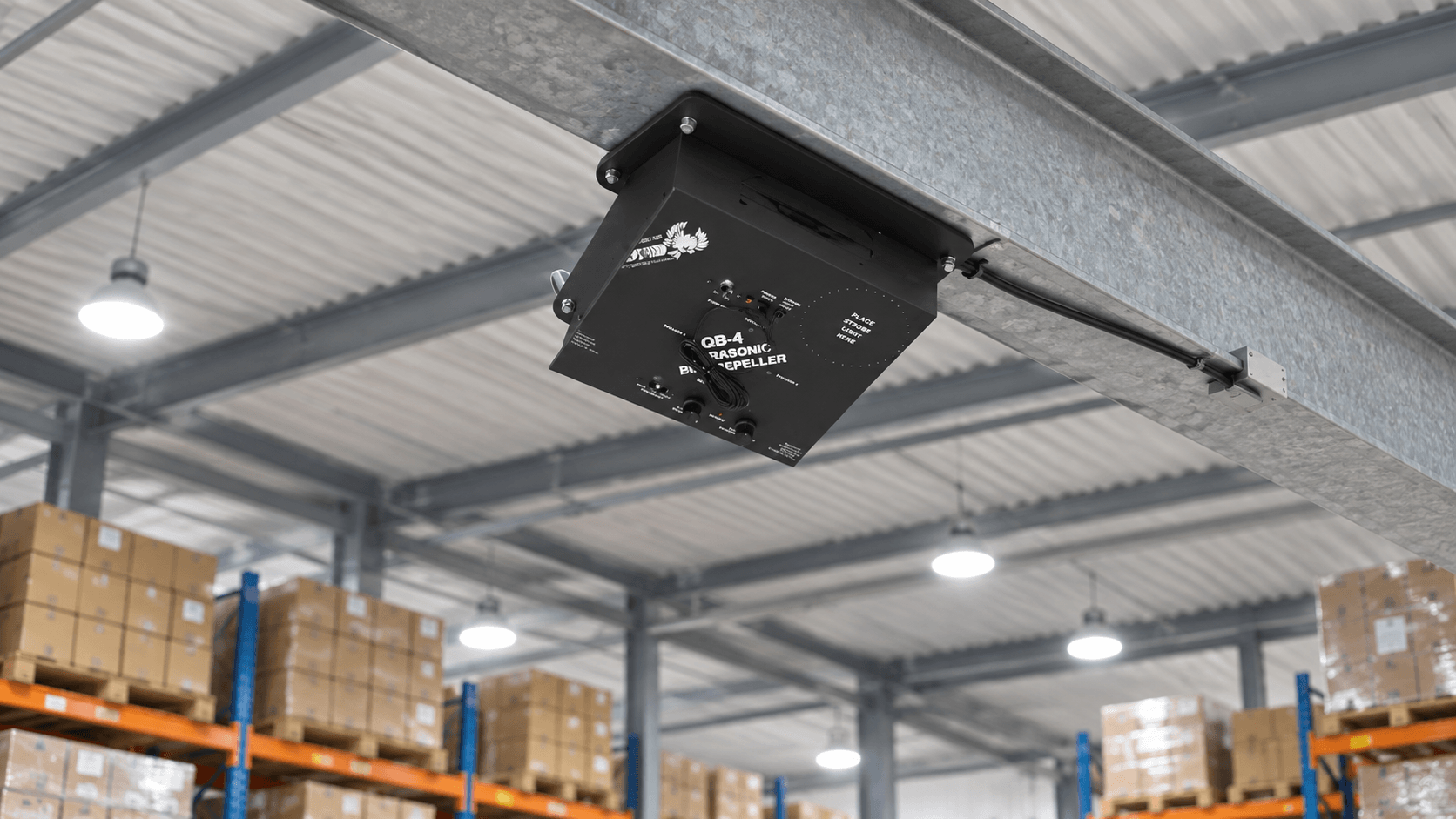
The QB4 ultrasonic bird deterrent device is one of the devices VFC PestMan uses to support bird deterrence in factories, warehouses and semi-enclosed areas.
The device operates within a frequency range of 22–30 kHz, creating an acoustic environment that reduces the tendency of birds to remain in the protected area. According to the manufacturer’s instructions, QB4 is suitable for enclosed or semi-enclosed spaces because surrounding surfaces help limit the dispersion of ultrasonic waves. Locations where the device may be considered include inside warehouses, beneath factory roofs, or covered loading, receiving and dispatch areas.
Installation location significantly affects the device’s operation. During actual implementation, VFC PestMan may remove, inspect, clean and reposition the device when bird congregation points change. The QB4 manufacturer also recommends combining the device with other deterrence or exclusion methods to improve the effectiveness of the bird-control programme.
3. Owl-face balls for visual bird deterrence
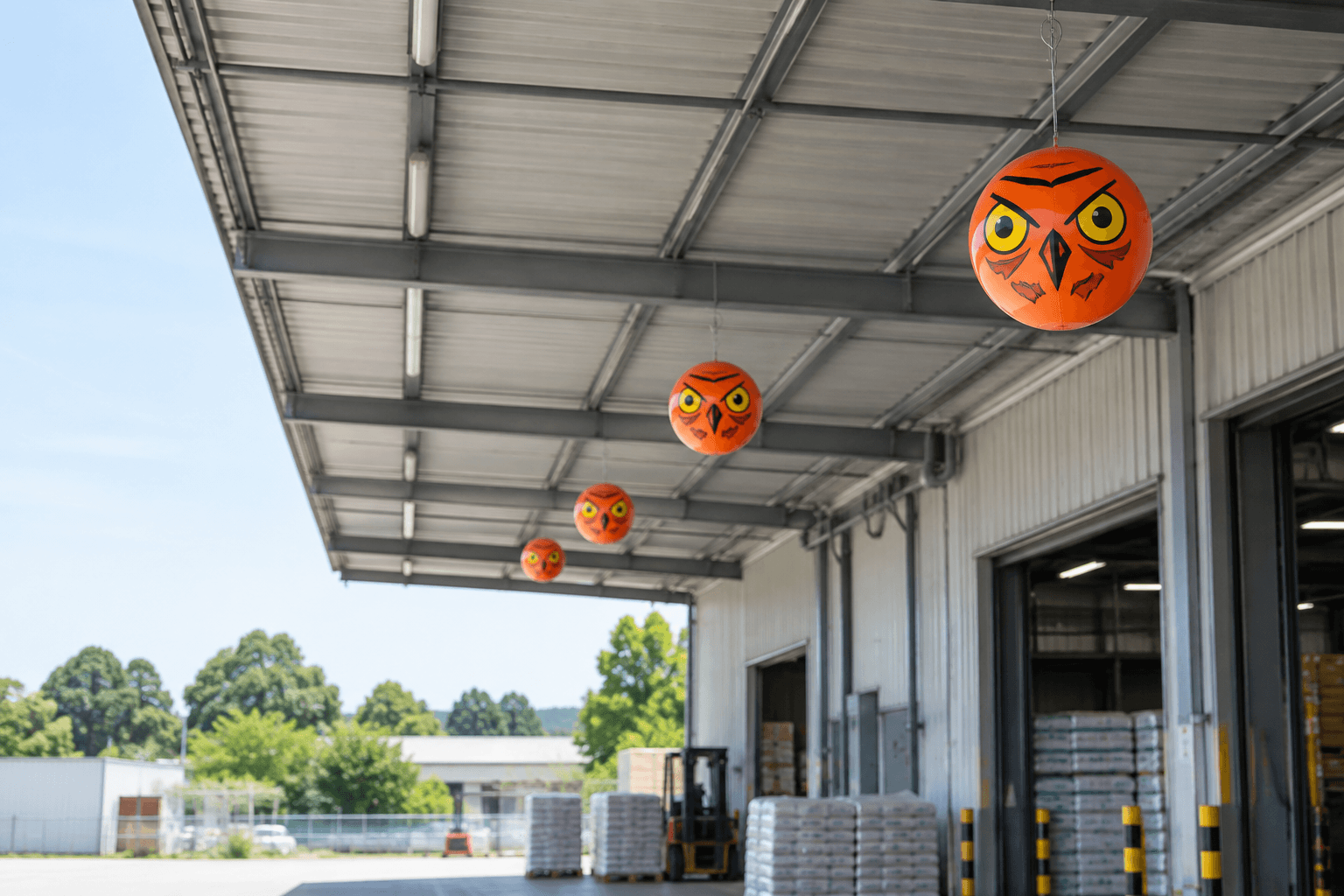
Round owl-face balls create a visual signal that simulates the presence of a predator, thereby increasing bird alertness in the area that needs protection. VFC PestMan may position these devices at warehouse doors, canopies, receiving and dispatch areas, conveyors or elevated open spaces where birds frequently appear.
The number of balls and their hanging locations need to be determined according to the area size, building structure and level of bird activity. During monitoring, their positions may be changed to maintain the deterrent effect. In factories, owl-face balls are often combined with QB4 ultrasonic bird deterrent devices, bird netting, anti-perching spikes and periodic nest removal.
4. Reflective discs to support bird deterrence
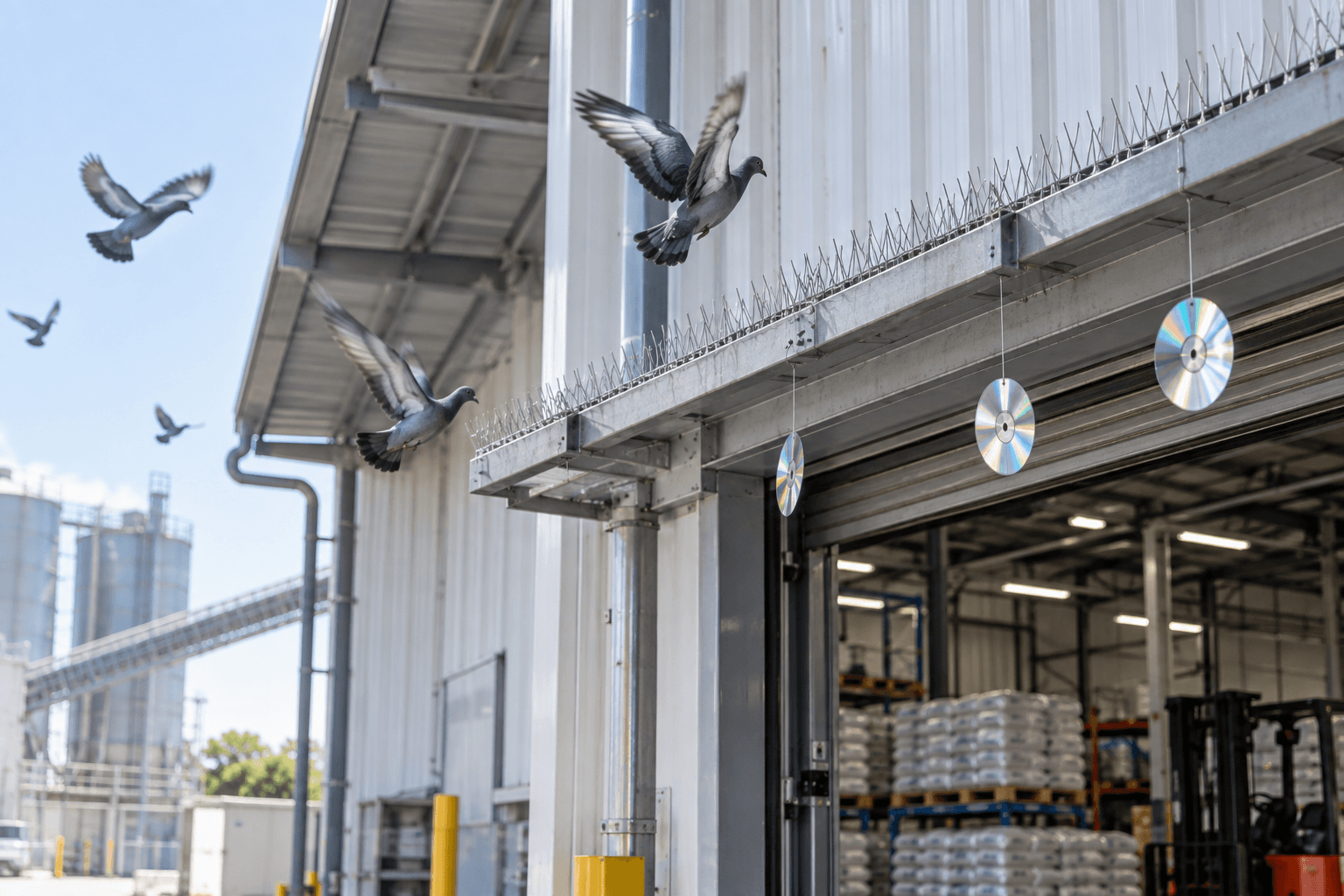
Reflective surfaces such as CDs can be used as a supporting measure in areas with suitable lighting and airflow. As the discs move, the reflected light continually changes, creating a visual signal that makes the area less stable for birds seeking a place to perch.
This method can be applied at canopies, areas outside warehouses, near entrances or at locations frequently visited by birds. Reflective discs are easy to install and reposition, making them suitable as a supporting measure within a programme that combines multiple bird-deterrence solutions.
5. Bird-repellent gel for frequently used perching locations
For ledges, railings, beams and other narrow surfaces where birds frequently land, VFC PestMan may consider using bird-repellent gel. This method is suitable for locations requiring localised treatment or areas where installing larger devices is difficult.
5.1. Bird Proof Gel bird-repellent gel
Bird Proof Gelis applied at locations where birds commonly perch, such as building ledges, roof eaves, railings, door ledges, beams and structural bars. The gel is placed directly on surfaces that birds use as stopping points, thereby supporting a reduction in perching activity in the area requiring protection.
This solution can be used independently at small problem points or combined with anti-perching spikes, bird netting and other deterrent devices depending on the building structure.
5.2. Bird Zero visual-effect gel
Bird Zero is a gel that creates a visual effect intended to form a warning signal for birds. The product can be placed on ledges, railings, roofs and other locations frequently accessed by birds.
The spacing and placement of the gel need to be determined according to the actual surface and the range of bird activity. This is an additional option for areas requiring a compact solution with minimal impact on the building’s structure and appearance.
6. Bird netting and anti-perching spikes help maintain deterrence results
Deterrent devices influence bird behaviour, while netting and spikes create direct barriers at locations frequently accessed by birds. Combining these two groups of solutions helps make the control programme more suitable for areas with different levels of risk.
Bird netting can be installed at canopies in front of receiving and dispatch areas, openings in front of warehouse doors, entrances to elevated raw material conveyors or other open spaces that birds frequently fly into. At certain locations, the factory may add protective net frames to limit bird access to interior areas.
Anti-perching spikes are suitable for ledges, roofs, beams and narrow structures where bird-perching activity has been clearly identified. When positioned correctly, the spikes help eliminate familiar landing points and support the continued effectiveness of the deterrent measures already implemented.
7. Bird-deterrent devices need to be inspected and adjusted periodically
Bird behaviour may change after an area has been treated. Birds may move to another beam, change their nesting location or find a new access route. Therefore, the control programme needs to include post-implementation monitoring. If birds move to a new perching location, this is also a point at which the pest management programme needs to be reassessed.
In actual projects, VFC PestMan may remove and inspect bird-deterrent devices, clean equipment, reposition devices, adjust the number of owl-face balls, add netting or spikes at newly identified problem points, and remove bird nests according to a periodic plan.
This approach allows the deterrence system to be adjusted according to actual conditions rather than remaining fixed while bird behaviour changes.
8. Reduce attractants and bird entry routes into the factory
Deterrence effectiveness also depends on surrounding environmental conditions. In raw material warehouses or conveyor areas, spilled materials need to be cleaned regularly from both elevated walkways and the floor below. Collected materials should be stored in securely tied bags or containers with lids to reduce food sources that attract birds and rodents.
Warehouse doors should be closed after personnel or vehicles pass through. At locations that need to remain open frequently, the factory may add plastic curtains, netting or appropriate protective frames. In addition, purlins, roof beams, signs, door gaps and column corners need to be inspected periodically to detect and remove bird nests before a stable nesting site becomes established.
For raw material storage areas, sanitation and pest control in food warehouses need to be combined to reduce attractants.
9. Bird-deterrence solutions suitable for different areas
Each area within a factory has different structural characteristics, levels of openness and levels of bird activity, so control methods need to be selected for each specific location. Areas inside warehouses or beneath factory roofs may be suitable for ultrasonic deterrent devices, while locations such as ledges, railings and beams may be more suitable for bird-repellent gel or anti-perching spikes. At warehouse doors, conveyor entrances and receiving and dispatch areas, solutions often need to include netting or other measures that directly prevent bird entry.
Solution selection therefore needs to be based on an on-site assessment, locations where birds frequently appear, movement routes, nesting points and the operating conditions of each area. In many cases, control effectiveness will be higher when deterrent measures, physical barriers and food-source management are combined rather than relying on a single device.
| Area | Solutions that may be considered |
| Inside warehouses, beneath factory roofs | QB4 ultrasonic bird deterrent device, owl-face balls |
| Canopies over receiving and dispatch areas | Owl-face balls, reflective discs, bird netting |
| Ledges, railings and beams | Bird Proof Gel, Bird Zero, anti-perching spikes |
| Warehouse doors that are frequently open | Netting, barrier curtains, door-opening management |
| Entrances to elevated conveyors | Protective net frames, bird netting |
| Locations where birds frequently nest | Sealing with netting, periodic inspection and nest removal |
| Areas with spilled materials | Sanitation, collection and food-source management |
The guidance table above helps businesses gain an initial understanding of solutions that may be suitable for each area. However, actual implementation always needs to follow the building structure, actual level of bird activity and bird behaviour, while continuous monitoring is required to adjust device locations for the best possible effectiveness.
10. How does VFC PestMan implement bird-deterrence solutions?
VFC PestMan approaches bird control based on the actual conditions of the facility. The technical team first identifies bird-perching locations, flight paths, nesting areas and factors attracting birds. Based on the assessment results, the solution may combine QB4 ultrasonic bird deterrent devices, owl-face balls, reflective discs, bird-repellent gel, bird netting or anti-perching spikes.
After implementation, bird activity continues to be monitored so that device locations can be adjusted, barriers can be added at new problem points, and nests can be removed according to plan. At the same time, VFC PestMan coordinates with the factory on managing warehouse doors, cleaning spilled materials and controlling conditions that may continue to attract birds.
This approach allows bird-deterrence solutions in factories to be developed for each area and adjusted according to actual conditions, in line with the facility’s operating characteristics.
You may also be interested in: Specialized Pest Control Services
11. Frequently asked questions
Which areas are suitable for the QB4 ultrasonic bird deterrent device?
QB4 is suitable for enclosed or semi-enclosed spaces such as inside warehouses, beneath factory roofs and covered loading areas. In large outdoor spaces, ultrasonic waves disperse more quickly, so the installation location and area of use need to be evaluated before installation.
Does a factory need to combine multiple bird-deterrence solutions?
It depends on the actual conditions of each area. A factory may simultaneously experience birds perching on beams, nesting in door gaps, searching for food around conveyors and entering through warehouse doors. Each issue requires an appropriate measure, so the control programme often combines multiple solutions.
Do owl-face balls and reflective discs need to be repositioned?
The locations of visual deterrent devices can be adjusted according to actual bird activity. Monitoring bird congregation points helps determine when device positions need to be changed or when additional devices are required.
Why is cleaning spilled materials important in bird control?
Spilled materials and food create attractants that encourage birds to continue visiting the factory. Regular cleaning, material collection and storage in enclosed containers help reduce favourable conditions for birds while supporting better effectiveness of deterrent measures.
In summary, effective bird deterrence requires a combination of multiple measures. QB4 ultrasonic bird deterrent devices, owl-face balls, reflective discs, Bird Proof Gel, Bird Zero, bird netting and anti-perching spikes each have their own scope of application. The key is to identify where birds are appearing, what factors are attracting them and which solution is suitable for the structure of each area.
If businesses are looking for a pest control company for businesses, need to survey the current pest situation or build a control program suitable for a factory, warehouse, hotel, or building, VFC PestMan can assist with on-site evaluation and propose solutions based on actual risks.
Hotline: (+84) 932669883
Email: contact@pestman.vn


Pheromone traps: An insect monitoring solution for pest control
Pheromone traps are applied in pest control due to their ability to attract...
Effective methods and processes for warehouse pest control
Kho hàng là nơi tập trung nguyên liệu, thành phẩm, bao bì, pallet và lượng…
Related news

Ready to eliminate audit risks and proactively protect customer experience & brand reputation?





Dear Valued Visitor,
To protect our clients' interests, all materials here are copyrighted and may not be reproduced without permission.
We appreciate your cooperation. Should you need to use our content professionally, please contact us directly.