







 PART
01
By VFC PestMan | 30-09-2026
Effective methods and processes for warehouse pest control
Warehouses are locations where raw materials, finished products, packaging, pallets and large volumes of goods are stored for extended periods. Insects may enter with incoming goods, vehicles or through warehouse doors, or may develop within stored lots when conditions are favourable.
Article content
Therefore, insect control in warehouses needs to cover the entire process from receiving and storage to dispatch, rather than being carried out only after insects have been observed.
1. Why are warehouses prone to insect activity?
Warehouses create many favourable conditions for pests to enter and survive. Goods arrive from multiple suppliers, transport vehicles continuously move in and out, and warehouse doors are frequently opened, while pallets, cardboard boxes and racking systems create many concealed spaces that are difficult to inspect.
In warehouses storing food, agricultural products, animal feed or dry materials, the goods themselves can become food sources for beetles and other stored-product insects. A shipment already containing insect eggs or larvae may continue to develop during storage if temperature and humidity conditions are suitable.
Warehouses storing non-food goods may still experience cockroaches, ants, termites, flies or rodents because of building conditions, waste, support areas and the surrounding environment. Insect control in warehouses therefore needs to consider both the type of goods being stored and how the warehouse operates.
2. How can insects enter a warehouse?
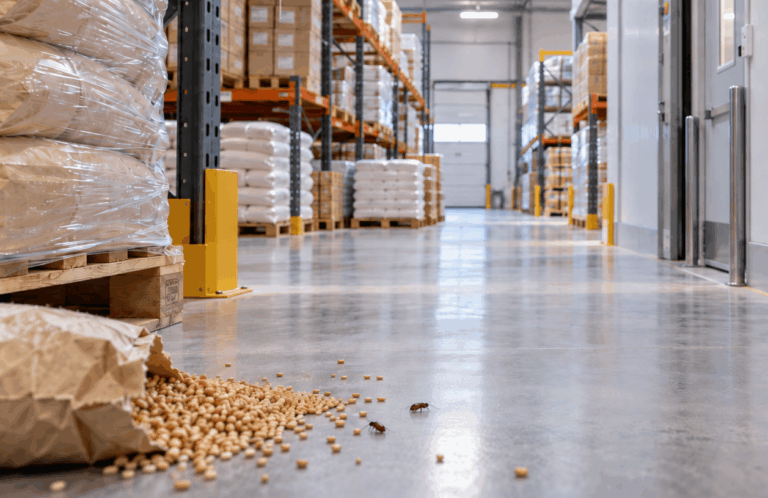
One of the most common routes is incoming goods. Material bags, cardboard boxes, packages and pallets may carry adult insects, eggs, larvae or pest signs. For stored-product insects, the infestation may already exist inside the product before the shipment reaches the warehouse.
Transport vehicles and receiving areas also create continuous connections between the outside and inside environments. When warehouse doors remain open for long periods, flying insects may gain access, while rodents and crawling insects may use gaps around the bottom of doors, wall edges or loading areas.
Gaps in walls, roofs, around pipes, technical doors and junctions between the building and the outside environment can also become entry routes. This risk increases when structures deteriorate or maintenance is not carried out in time.
In addition, pests may originate within the warehouse premises themselves. Waste, damaged goods, spilled materials, standing water and areas that have not been cleaned for long periods provide favourable food sources and harbourage.
3. Which insects are commonly found in warehouses?
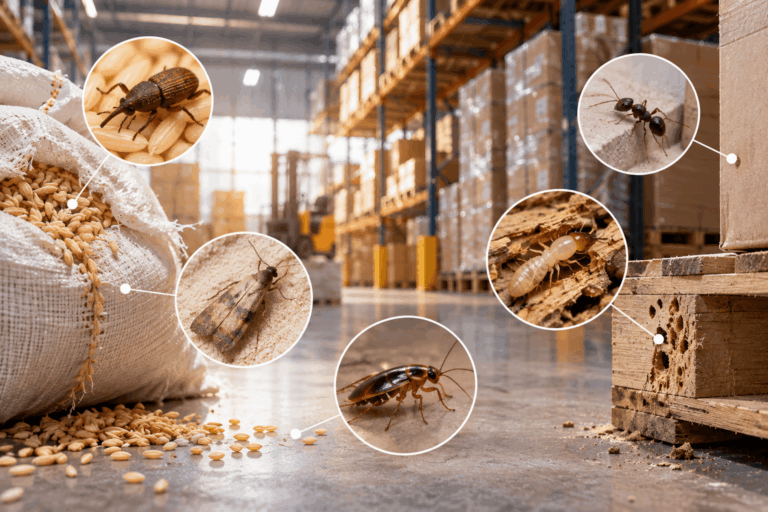
The first group requiring attention in dry-material warehouses is stored-product insects. Rice weevils, grain weevils, sawtoothed grain beetles, stored-product moths and many small beetle species can directly damage seeds, flour, grains, spices, animal feed and plant-based materials.
Some species develop inside grains or bags of materials, making them difficult to detect at an early stage. By the time adult insects appear outside the packaging, the shipment may already have contained an infestation for some time.
Cockroaches and ants are often found along wall edges, in gaps, sanitation areas, support areas or locations with spilled food. These groups can move between multiple areas and require control of both harbourage and food sources.
Flies and other flying insects are often associated with food products, organic matter, waste areas and frequently opened doors. Warehouses located near production or processing areas may also experience insect pressure from adjacent areas.
In addition to insects, rodents are an important target within warehouse pest management programmes. Rodents can tear packaging, gnaw goods, damage electrical wiring and leave signs in storage areas. Therefore, warehouse-control systems generally need to monitor insects and rodents in parallel.
If rodents continue to appear despite traps being in place, review the reasons why they repeatedly return to factories and warehouses
4. Do all types of warehouses face the same insect risks?
No. The type of goods, temperature conditions, storage duration and operating practices strongly influence which pest groups need to be prioritised.
Food and food-ingredient warehouses often face a high risk from beetles, moths, cockroaches, ants, flies and rodents. The control programme needs to pay particular attention to incoming goods, storage duration and packaging condition.
Cold-storage warehouses operate at low temperatures but still have multiple pest-entry routes through doors, transition areas, goods, pallets and support areas. Rodents, cockroaches or insects travelling with goods can still become a problem. This type of warehouse needs to be assessed separately because its temperature conditions and operating structure differ from those of conventional warehouses.
Agricultural-product and dry-material warehouses face notable risks from stored-product insects. Monitoring shipments, temperature, humidity and storage duration plays an important role in early detection.
Finished-goods warehouses need to prioritise packaging protection and maintain clean storage areas. Once insects or rodents gain access to finished goods, the impact may directly affect shipments being prepared for dispatch.
Warehouses storing pharmaceuticals, medical supplies and goods with stringent storage requirements place greater emphasis on hygiene conditions, traceability and control of entry points. Pest tolerance at these facilities is generally very low.
Therefore, an overall programme needs a common management framework followed by more specific guidance for each warehouse type. Cold-storage pest control, food-warehouse insect control and raw-material warehouse insect control should be developed as separate guidance groups.
5. Warehouse insect control should begin with incoming goods
The receiving area is the first layer of control. If the source of infestation is detected before the shipment moves deeper into the warehouse, the business can significantly reduce the risk of spread to other locations.
For food warehouses, see also how to control pests from goods receiving through storage.
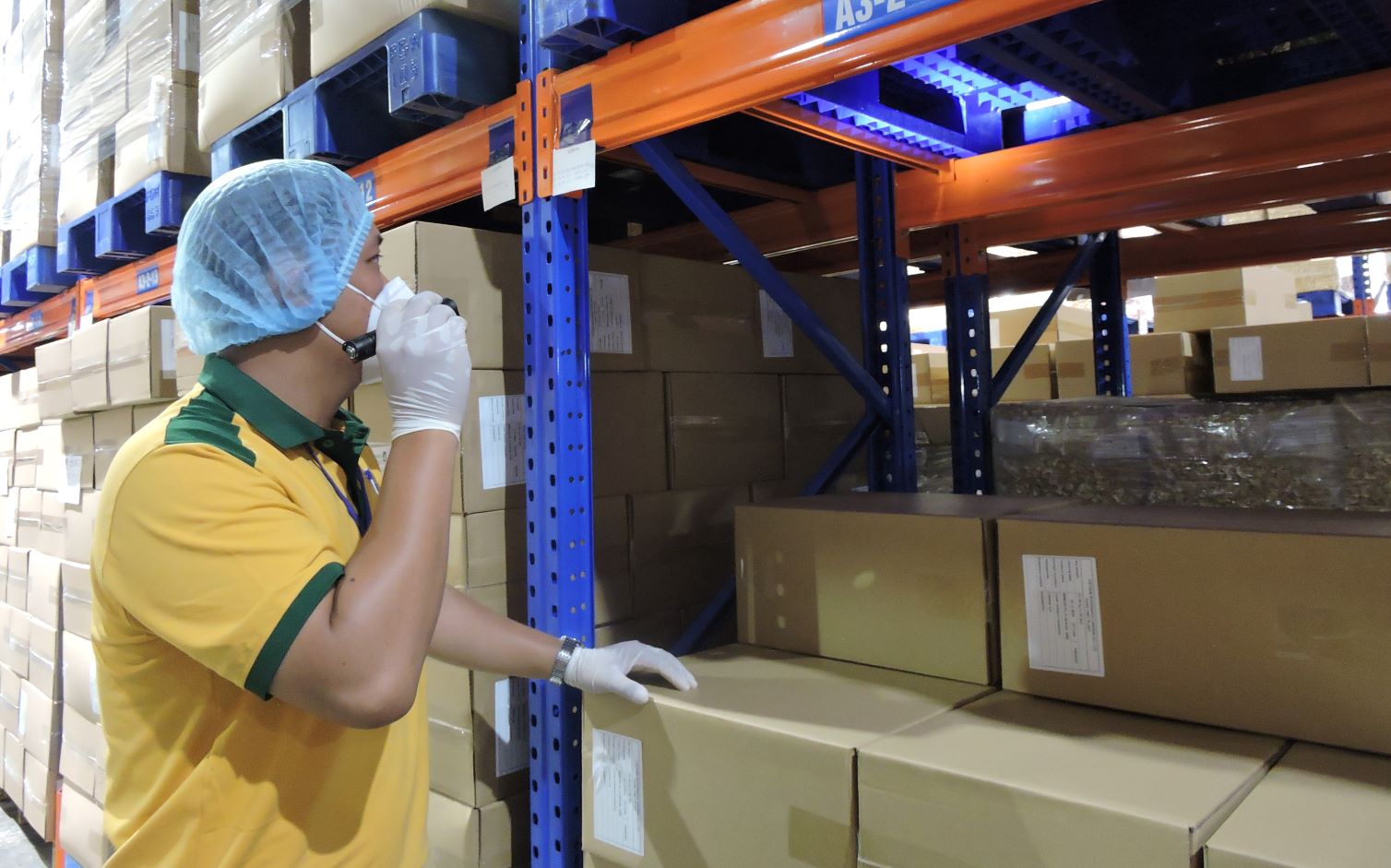
Warehouse personnel should inspect packaging condition, pallet undersides, cardboard boxes and package surfaces. Torn packaging, unusual small holes, live or dead insects, webbing, unusual material dust and gnaw marks all need to be recorded.
For food products or sensitive materials, shipments showing suspicious signs should be assessed before being stored together with compliant goods. This creates an early control point within the management chain.
Transport vehicles also need attention where operating conditions allow. Even a well-cleaned warehouse may continue to experience insect problems if infestation sources are repeatedly introduced with incoming goods.
6. How does goods arrangement affect pest-control capability?
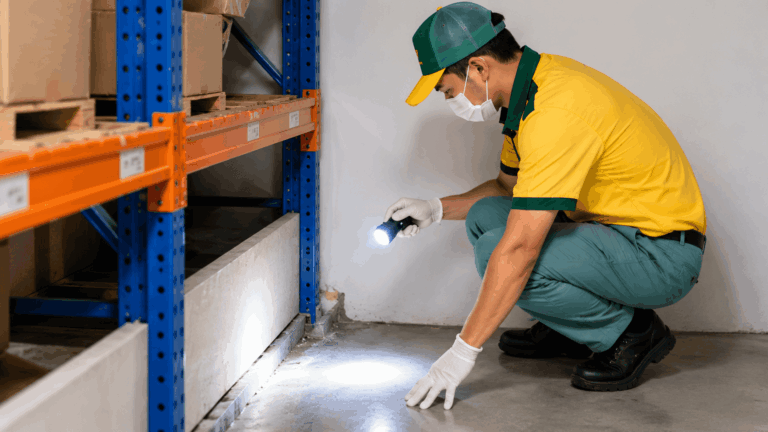
An overcrowded warehouse reduces inspection capability. When pallets are stacked close to walls, goods block rack bases or aisles become narrow, personnel have greater difficulty detecting rodent droppings, dead insects, gnawed goods and other abnormal signs.
The warehouse needs to maintain appropriate clearance around goods for cleaning, inspection and access to monitoring devices. Specific clearance distances should be determined according to warehouse design, safety requirements and internal procedures rather than applying one fixed figure to every facility.
Blind spots, long-stored inventory and low-turnover areas require greater attention. These are locations where insects may complete their development cycle with little detection.
Appropriate inventory management also supports pest control. Limiting excessively long storage periods helps reduce the risk of stored-product insects developing through multiple generations within the same lot of material.
7. Warehouse sanitation needs to focus on food sources and harbourage
Flour dust, spilled grains, damaged packaging or goods spilled beneath racks can provide enough food to sustain a small insect population for an extended period. Therefore, warehouse sanitation needs to include concealed areas rather than focusing only on main aisles.
Areas beneath pallets, rack bases, wall corners, gaps between equipment and spaces behind long-stored inventory need to be included in the sanitation schedule. Damaged goods and materials no longer in use should be removed from the warehouse according to appropriate procedures to avoid creating additional harbourage.
Waste and organic matter need to be collected at a frequency appropriate to the volume generated. For food warehouses or areas adjacent to production, waste houses and by-product collection points can directly affect fly, cockroach and rodent pressure around the warehouse.
8. How can insects be prevented from entering from outside?
Warehouse doors, secondary doors, gaps beneath doors, pipes passing through walls and roof junctions are points that should be inspected periodically. When openings are detected, businesses can reinforce or seal them using solutions appropriate to the structure.
Receiving doors need to be managed according to actual operations. The longer they remain open, the greater the likelihood that flying insects or other pests from outside will gain access. Door systems, barriers or supporting devices need to be maintained to preserve their function.
Areas outside the warehouse also affect pest pressure. Tall grass, materials left for long periods, standing water or accumulated waste near the building can provide harbourage before pests find a route inside.
This approach creates a preventive layer at the perimeter instead of waiting until insects have entered the warehouse before taking action.
9. How should a warehouse monitoring system be designed?
Monitoring devices help businesses understand where pests are occurring and how trends are changing. Depending on the target pest, the system may include glue traps, specialised stored-product insect traps, insect light traps or rodent-monitoring devices. For receiving areas, businesses can refer to LED light-trap placement for monitoring flying insects.
Monitoring points need to be positioned according to risk level. Doors, receiving areas, raw material warehouses, areas near long-stored inventory and locations with a history of pest occurrence generally require greater attention.
Each point should have a clearly defined location on the map and be inspected according to schedule. Monitoring capability is affected when devices are blocked by pallets, moved from their designated locations or become difficult to access.
The greatest value of the system lies in data collected across multiple inspection cycles. Capturing a few individuals once only reflects conditions at that inspection point in time, while a continuous upward trend at the same location is a signal that the underlying cause needs further investigation.
10. Why is correct identification of warehouse insects important?
Stored-product insect species have different behaviours and food sources. Some develop inside materials, while others live outside grains and feed on fragments or damaged products.
Correct identification helps narrow the scope of investigation. If the insects are associated with a specific material, the business can inspect the corresponding shipment, supplier and storage area. If insects are concentrated around doors or outside warehouse areas, entry routes from the external environment need to be prioritised.
Incorrect identification can lead to treatment of the wrong area. Adult insects observed on the surface may sometimes be only a visible sign, while the actual source of infestation lies inside the goods or at another location.
11. When should treatment measures be used?
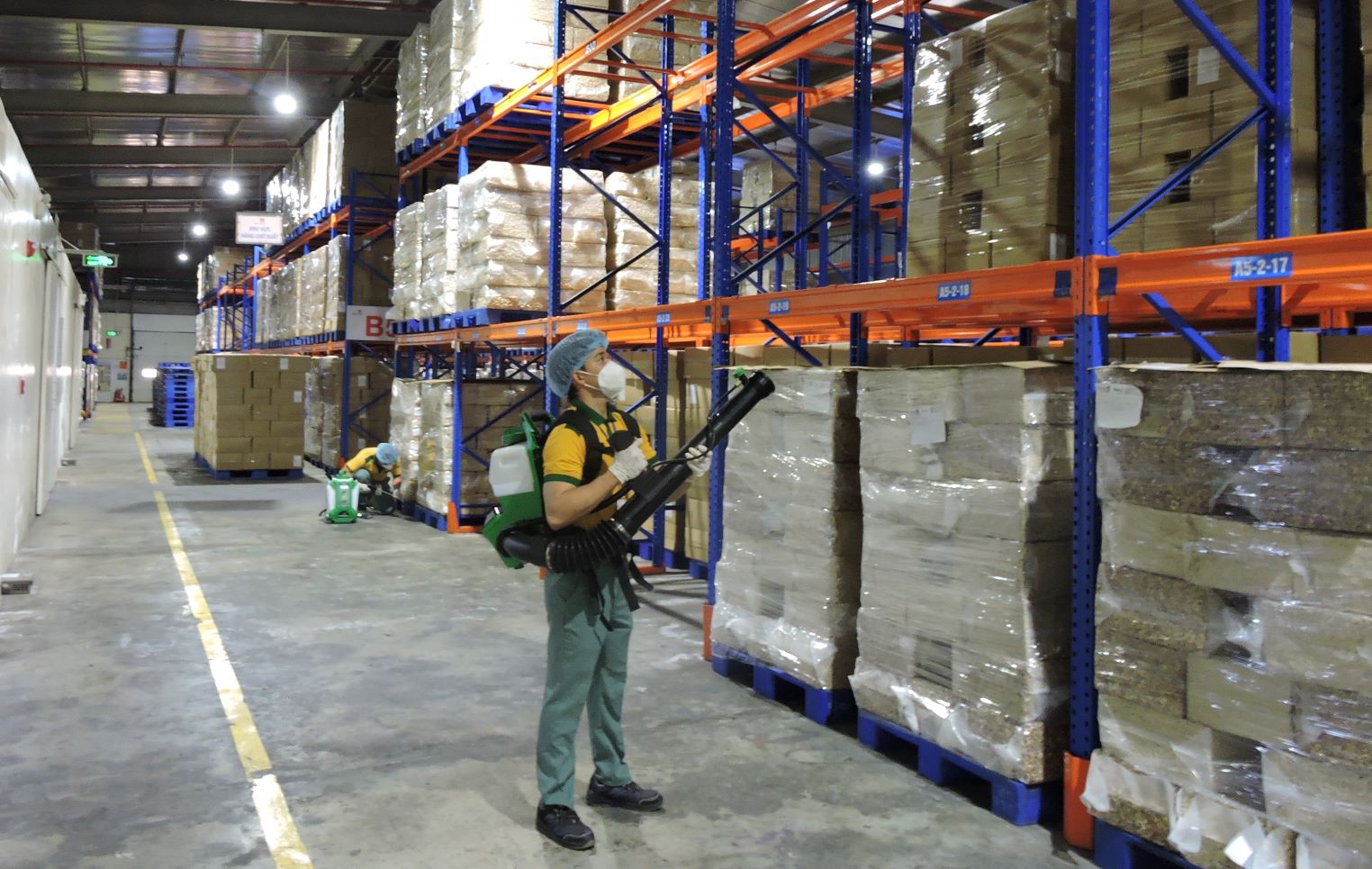
Treatment measures should be selected after identifying the target pest, level of occurrence and affected area. Each warehouse type has different requirements regarding goods, people and safety conditions, so methods also need to be adjusted accordingly.
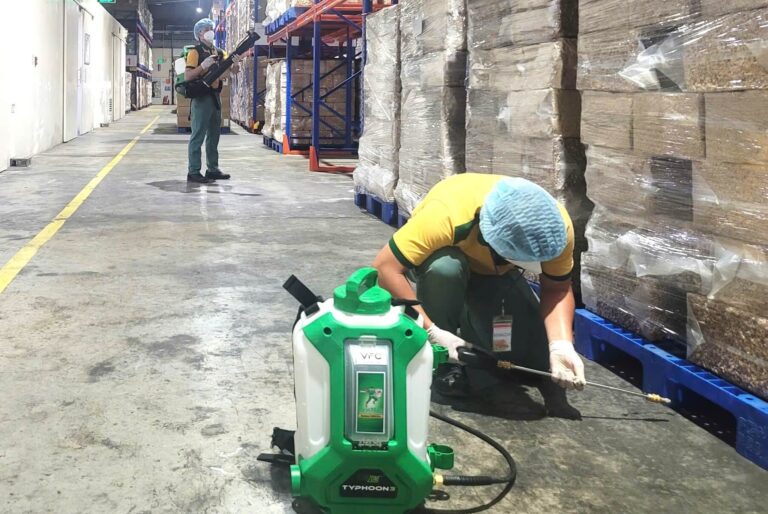
In many cases, improving sanitation, separating suspected shipments, addressing gaps and adjusting storage practices can significantly reduce conditions favourable to pests. When traps, devices or pest-control products need to be used, their placement and application method must be appropriate for the area.
For food warehouses, pharmaceutical warehouses or other sensitive environments, controlling the risk of contact with goods needs to be prioritised. Chemical measures need to comply with product labels and the facility’s safety procedures.
12. What components does warehouse IPM include?
Integrated Pest Management, or IPM, connects multiple activities into a unified programme. In warehouses, key components include assessment, species identification, incoming-goods inspection, sanitation, inventory management, entry prevention, monitoring and treatment according to risk level.
This model helps businesses identify causes instead of focusing only on visible insects. If beetles repeatedly appear in the same area, the programme should lead to a review of the material lot and storage duration. If fly numbers increase around receiving doors, door operations and the outside environment need to be assessed.
Data from the monitoring system help businesses evaluate results after each change. Control measures can then be adjusted according to the warehouse’s actual conditions.
13. What data should be tracked for warehouse insect control?
Required information generally includes device location, inspection date, pest type recorded, number or activity level, device condition and abnormalities observed on site.
Pest-monitoring data should be compared by area and over time. A sudden increase at one point may be related to a new shipment, an improperly sealed warehouse door, changes in storage arrangement or inadequate sanitation activities.
For businesses with a quality-management team, these data also help relevant departments coordinate more clearly. The warehouse team is responsible for goods and storage arrangement; maintenance addresses structural issues; sanitation removes food sources; and the pest-control team monitors devices and trends.
When each finding leads to a specific action, the control programme will more accurately reflect actual operating conditions.
14. What common mistakes cause insects to recur in warehouses?
A common mistake is treating only the area where insects are seen without investigating the source of infestation. This often occurs with beetles and moths when adults appear outside while the infestation source remains within the goods.
Storing goods too close to walls or obstructing monitoring devices also reduces the ability to detect problems early. Similarly, retaining damaged pallets, old cardboard boxes and unnecessary materials creates additional harbourage.
Keeping the same sanitation schedule while production volume or inventory increases can also create gaps in control. Warehouses entering peak season often need to reassess sanitation and inspection frequency.
Another issue is having data without analysing them. If the same trap repeatedly records increasing pest density but the programme only replaces the trap and continues monitoring, the actual cause may still remain.
15. How often should insects in a warehouse be inspected?
There is no single inspection frequency suitable for every warehouse. Frequency needs to be based on the type of goods, risk level, history of occurrence, environmental conditions and the business’s management requirements.
Food warehouses or warehouses storing sensitive materials generally require a tighter monitoring system than warehouses storing goods that are less attractive to pests. Areas with previous incidents may also need more frequent inspection for a period to evaluate post-treatment results.
When the warehouse layout changes, inventory volume increases or the warehouse enters peak season, the inspection plan should be reviewed. The programme needs to change along with operations rather than remain unchanged for long periods.
16. What additional factors require attention in food-warehouse insect control?
Food warehouses face specific risks because the goods themselves can provide both food sources and an environment for insect development. Seeds, flour, grains, spices, dried fruit and animal feed are among the material groups requiring particular attention to stored-product insects.
Supplier inspection, lot management, storage conditions and storage duration are important parts of the programme. When a stored-product insect is detected, identifying which goods are involved is often more meaningful than treating only the surrounding space.
Food warehouses also need to control cockroaches, flies and rodents because these groups may affect hygiene and goods quality. Because of these specific characteristics, food-warehouse insect control should be treated as a separate topic within the warehouse-management system.
Learn more: Food-warehouse pest control procedures for managing risk by individual shipment
17. Are cold-storage warehouses less at risk of pests?
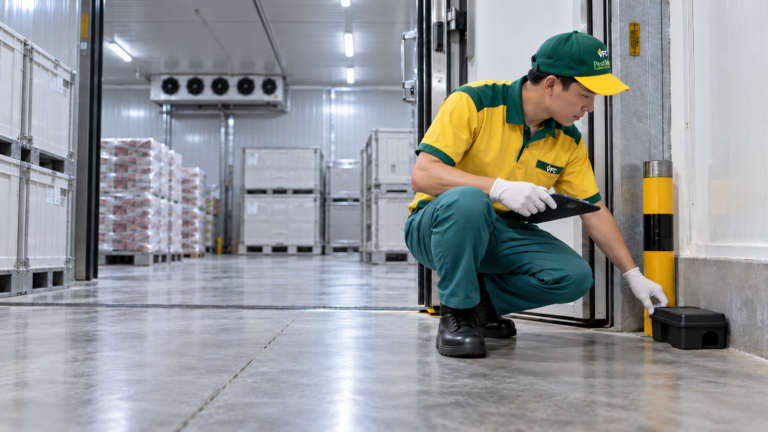
Low temperatures may reduce the activity of many species, but this does not mean that cold-storage warehouses are automatically free from pests. Goods are still transported in, doors still need to be opened and transition areas remain connected to the outside environment. In particular, businesses should inspect 5 pest-control blind spots in cold-storage warehouses around doors, buffer areas and technical locations.
Rodents may be active around the warehouse or move through technical areas. Cockroaches and insects may occur in buffer areas, around doors, in machinery rooms or travel with goods. Stored-product insects may also already be present inside products before they are placed under cold-storage conditions.
Panel structures, warehouse doors and service routes create additional locations requiring specific inspection. Therefore, pest management in cold-storage warehouses needs to be developed according to cold-storage operating characteristics rather than simply using the same programme applied to conventional warehouses.
18. Frequently asked questions about warehouse insect control
Can insects still appear in a clean warehouse?
Yes. Good sanitation reduces many favourable conditions, but insects may still enter with raw materials, goods, pallets, vehicles or through structural gaps.
Why do beetles continue to appear in a warehouse even after cleaning?
The infestation source may be within the goods or a stored material lot. When the issue recurs, each group of goods, storage duration and receiving history need to be reviewed.
Do cold-storage warehouses need a pest management programme?
Yes. Low temperatures do not completely eliminate risk. Door areas, transition zones, incoming goods, technical structures and the surrounding environment still need to be monitored.
Do pallets need to be inspected before entering the warehouse?
Pallet and package conditions should be inspected at the receiving area. This is one of the steps that helps detect pest signs before goods are moved deeper into storage.
Is periodic pesticide spraying sufficient to control insects in warehouses?
Control effectiveness depends on multiple factors, including the source of infestation, sanitation, goods, structure and monitoring. A programme based mainly on periodic spraying may overlook the causes that allow insects to continue recurring.
What should be done when insects are detected in a shipment?
The shipment needs to be assessed and managed according to internal procedures to limit the risk of spread to surrounding goods. At the same time, the insect species, extent of impact and possibility that the infestation source is related to incoming goods need to be determined.
19. Warehouse insect control needs to be managed across the entire goods flow
The effectiveness of warehouse insect control depends on the ability to manage the entire process from incoming goods and receiving areas through storage and dispatch. Goods, sanitation conditions, building structure and the surrounding environment can all affect the risk of pest occurrence.
An appropriate programme needs to connect incoming-goods inspection, warehouse arrangement, sanitation, entry prevention, the monitoring system and data over time. When the warehouse type changes, the programme also needs to address the specific risks of food warehouses, cold-storage warehouses, raw material warehouses, finished-goods warehouses and specialised storage models.
This provides the foundation for businesses to detect risks earlier, identify the correct causes and develop control measures suited to actual operating conditions. Are insects frequently appearing in your warehouse? Learn more about PestMan’s insect and rodent control services.
If businesses are looking for a pest control company for businesses, need to survey the current pest situation or build a control program suitable for a factory, warehouse, hotel, or building, VFC PestMan can assist with on-site evaluation and propose solutions based on actual risks.
Hotline: (+84) 932669883
Email: contact@pestman.vn
PART
01
 PART
02
Mistakes that cause insects to recur in warehouses
 PART
03
Pest control in food warehouses: Risks, procedures, and IPM solutions
 PART
04
Comprehensive insect control strategy for food logistics warehouses and F&B supply chain
 PART
05
Pest control in cold storage facilities: 5 blind spots businesses often overlook

Ready to eliminate audit risks and proactively protect customer experience & brand reputation?






Dear Valued Visitor,
To protect our clients' interests, all materials here are copyrighted and may not be reproduced without permission.
We appreciate your cooperation. Should you need to use our content professionally, please contact us directly.