







 PART
01
By VFC PestMan | 30-09-2026
Pest control in pharmaceutical manufacturing plants
Pharmaceutical factories contain many areas with very different levels of sensitivity, ranging from perimeter fences and receiving warehouses to production areas, packaging areas, finished-goods warehouses and technical rooms. Therefore, pest management in pharmaceutical factories needs to be designed according to the risk level of each area, prioritising prevention, monitoring and entry prevention before direct treatment measures are considered.
Article content
1. Why do pharmaceutical factories need risk zoning in pest management?
A pest management programme applied in the same way throughout the entire factory may not accurately reflect actual operating conditions. Perimeter areas may be exposed to pressure from rodents and insects in the surrounding environment, while production or packaging areas require a higher level of control because they are directly related to quality and hygiene.
Risk zoning helps businesses determine which areas require close monitoring, which areas can maintain basic monitoring and which areas need to minimise chemical use. It also provides a basis for device placement, determining inspection frequency and establishing appropriate action thresholds.
For pharmaceutical factories, risk levels need to be determined within the quality management system and the GMP requirements currently applied at the facility. The QA team can refer to GMP requirements related to pest management, sanitation and contamination prevention when comparing them with the current programme.
In pharmaceutical-factory pest management, the value of risk zoning lies in its ability to focus resources on the correct risk points. QA, HSE, maintenance and the pest control provider can also coordinate more easily when the responsibilities and priority level of each area have been clearly defined.
2. Perimeter areas: The factory’s first layer of control
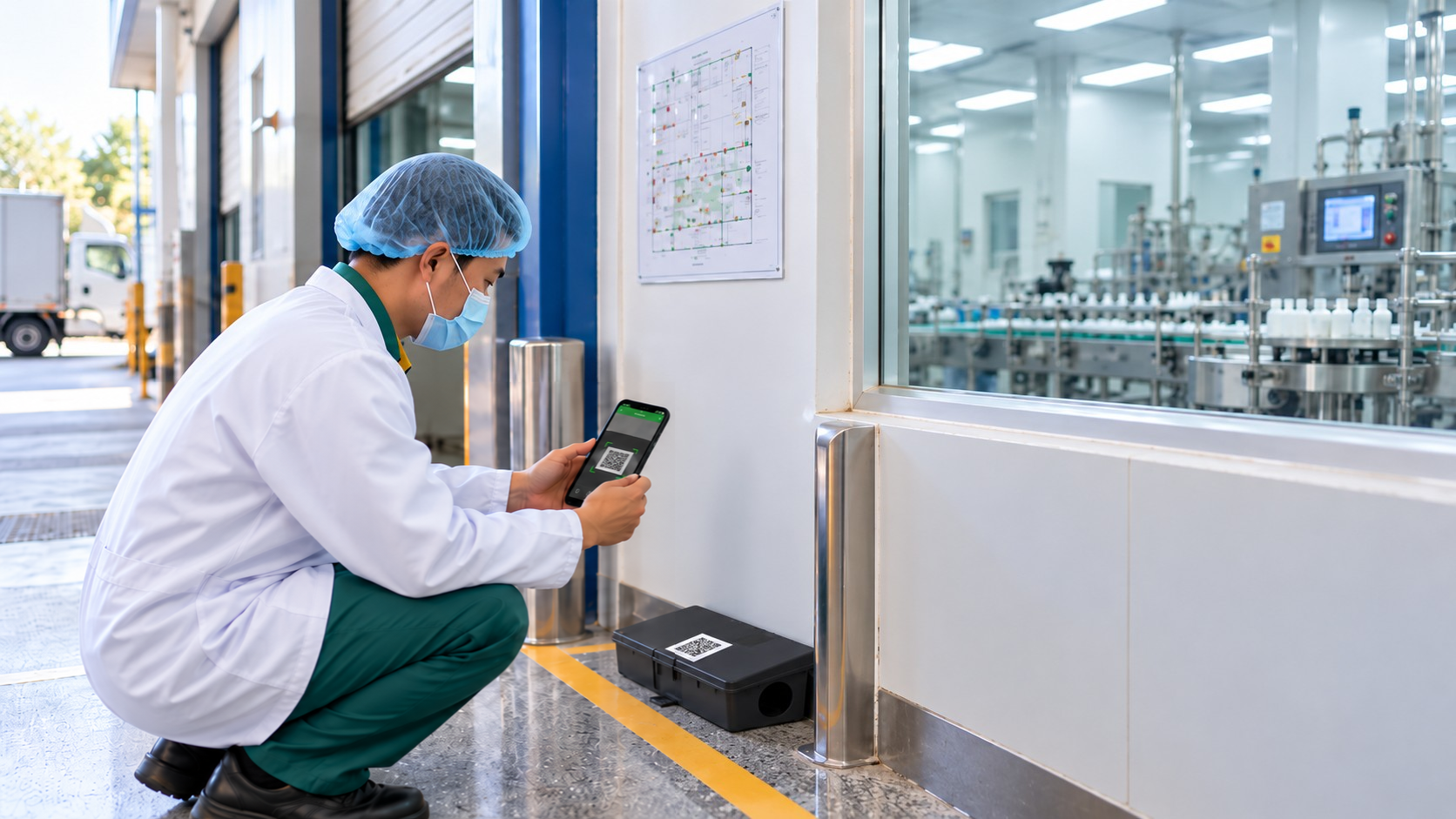
Perimeter fences, landscaping, material staging areas, waste houses, outdoor technical areas and boundaries adjoining the surrounding environment are points that need to be inspected regularly. Rodents, crawling insects, mosquitoes and certain other pests often approach the factory from these areas.
The objective at the outer perimeter is to reduce pest pressure before pests reach the building. Landscaping needs to be kept tidy, outdoor materials arranged appropriately, and points that may provide food or harbourage need to be controlled.
The perimeter rodent-monitoring system also helps businesses identify areas where rodent activity is increasing. If signs are concentrated along a section of the fence or near a material storage area, the inspection scope can be expanded before rodents reach warehouse doors or production areas.
3. Receiving and dispatch areas: High-risk transition points
Raw material receiving and dispatch areas are places where vehicles, pallets, cardboard boxes and personnel continuously move between the outside and inside of the factory. These are also among the routes through which pests may enter with goods or take advantage of open-door periods to gain access.
Inspection in this area needs to focus on door conditions, gaps beneath doors, junction points, pallet areas and temporary goods-staging locations. Rodent signs, insects or packaging with abnormal signs need to be recorded at the receiving stage.
For raw materials or packaging supplied by multiple vendors, the receiving procedure should also include a visual check of hygiene conditions. This helps reduce the risk of introducing a source of infestation deeper into the warehouse or production area.
4. How should raw material and packaging warehouses be monitored?
Raw material and packaging warehouses often contain high volumes of goods, numerous racks and many concealed spaces. These conditions can provide harbourage for rodents, cockroaches or small insects if sanitation and inspection clearances are not properly maintained.
In addition to rodent signs, warehouse personnel need to pay attention to damp areas, concealed corners, pallets and pipes where cockroaches may harbour. The article 5 Cockroach hotspots in factories during hot and humid weather can help warehouse personnel identify additional areas that need to be inspected.
Monitoring devices need to be placed along risk routes while remaining easily accessible for inspection. Goods stacked too close to walls or blocking monitoring points will reduce the ability to detect early signs.
Raw material lots stored for long periods also require attention. Packaging condition, gnaw marks, rodent droppings or dead insects around pallets are all signs that need to be recorded to determine the level of risk.
5. Production areas require the strictest level of control
Production areas typically have stringent requirements for hygiene, safety and the control of factors that may affect products. Therefore, pest management measures in these areas need to be considered more carefully than those used in perimeter areas.
The focus should be on preventing entry, controlling environmental conditions and using appropriate monitoring devices. Service gaps, doors, ceilings, pipes passing through walls and junctions between areas need to be inspected periodically.
If pests are detected in a production area, the business needs to accurately record the location, type of sign, time and related factors. An incident in a sensitive area should lead to an assessment of the cause rather than treatment only at the visible location.
6. Packaging areas and finished-goods warehouses should prioritise early detection
Packaging areas and finished-goods warehouses are locations where products have already passed through most of the production process. Pest signs in these areas can create significant risks related to quality, hygiene and traceability.
Rodents, cockroaches or flying insects appearing in these areas need to be assessed with a higher level of priority than those in perimeter areas. The monitoring system needs to be sufficiently clear for responsible personnel to know exactly which point has recorded an abnormality and how the trend is changing.
Data over time are particularly important in finished-goods warehouses. Repeated findings at the same point may indicate that an entry route has not been addressed or that changes in goods arrangement are creating a new risk.
7. Technical rooms and support areas are often overlooked
Electrical rooms, machinery areas, maintenance rooms, tool stores, technical ceilings and low-traffic areas often contain numerous gaps and concealed spaces. These may become harbourage areas for rodents, cockroaches, lizards or other pests.
For lizards in particular, the factory needs to consider insect food sources, harbourage locations and gaps leading into the building at the same time. The maintenance team can refer to the IPM-based guide to lizard control in factories when coordinating treatment of entry routes.
Because these locations are not directly within production areas, they are sometimes inspected less frequently. However, piping systems and technical cables may connect to many other areas of the factory, creating movement routes for pests.
The IPM programme needs to include these points on the risk map and determine an appropriate inspection frequency. Addressing gaps and keeping technical areas tidy helps significantly reduce harbourage.
8. How should areas with restricted chemical use be controlled?
Pharmaceutical factories often contain areas where chemical use needs to be restricted or very tightly controlled. In these areas, the programme needs to prioritise physical, mechanical and preventive measures.
Measures may include sealing gaps, installing appropriate screens, managing doors, controlling food sources, using mechanical traps and monitoring insects with monitoring devices. The objective is to reduce the likelihood of pests reaching the area before direct treatment becomes necessary.
If pest-control products need to be used, the treatment plan must be evaluated according to the characteristics of the area, operational requirements and the factory’s safety procedures. Their use needs to be clearly controlled in terms of location, time and scope.
9. What should pharmaceutical factories pay attention to in rodent control?
Rodents can access the factory through fences, doors, service routes, receiving and dispatch areas and structural gaps. Warehouses, support areas and perimeter zones are typically locations where a clearly defined monitoring system is needed.
Effective rodent control needs to combine three approaches: reducing pressure from the outer perimeter, blocking entry routes and monitoring activity inside the facility. Traps are effective only when they are placed along the correct routes and inspected based on monitoring data.
If signs repeatedly appear in the same area, the business needs to recheck gaps, food sources, materials and changes to the layout. Increasing the number of traps without first identifying the cause is often unlikely to resolve recurrence.
10. Flying insects need to be monitored using data
Flies and other groups of flying insects may enter through doors or be attracted by lighting and the outside environment. Insect light traps help monitor insect numbers, locations and trends over time in appropriate areas.
Data need to be reviewed for each individual point. If a device records a continuous increase in insect density, the business should inspect nearby doors, light sources, sanitation conditions or changes in surrounding activities.
Light-trap placement also needs to be reassessed periodically when the layout changes. A device blocked by shelving or left in an unsuitable position after a layout change may no longer accurately reflect the risk.
For receiving and dispatch areas, warehouses and locations near entrances, the use of insect light traps needs to be based on insect movement routes and the sensitivity level of the area. Businesses can refer to guidance on LED light-trap placement and flying-insect monitoring in factories when evaluating the existing system.
11. Data are a core component of a risk-based IPM programme
A pest management programme in a pharmaceutical factory needs to generate sufficient data for responsible personnel to track changes. Point maps, device IDs, inspection results, on-site images and corrective actions need to be linked to one another.
Data over time help QA identify which areas are stable and which are showing an increasing trend. If the same point repeatedly records activity, the business can return to assess the cause rather than treating each incident separately.
The PestMan App and PestMan Dashboard can support the recording and consolidation of data by location, making it easier for responsible personnel to track history and trends when a factory has many monitoring points.
12. When should the level of control for each area be adjusted?
Risk zoning needs to be updated when the factory changes its layout, production lines, entrances, warehouses or material flow. An area that previously had a low risk level may become an area requiring attention after operational changes.
A continuous increase in data at one point is also a signal that the level of control should be reviewed. Inspection frequency, device location or assessment scope may need to be adjusted accordingly.
After major repairs, construction work or maintenance activities, the factory should also reassess newly created gaps and technical routes. These are times when pests may find new entry routes.
>> Read more: Signs that it is time to reassess the pest management programme
13. Common mistakes when developing a pest management programme for pharmaceutical factories
The first mistake is placing devices at fixed intervals without considering risk. This may result in insufficient monitoring in high-risk areas while low-risk areas have too many devices.
Another mistake is keeping the same map for a long period even though the layout has changed. The map needs to reflect actual site conditions for the data to remain meaningful.
Another issue is focusing only on pest numbers without tracking the causes. Gaps, food sources, humidity and operational changes need to be analysed together with trap data.
14. How should QA, HSE, maintenance and the pest control provider coordinate?
QA typically monitors data, documentation and the level of impact on quality. HSE focuses on methods, safety and chemical use. Maintenance is responsible for gaps, doors, screens and infrastructure. The pest control provider is responsible for assessments, monitoring and recommending technical control measures.
When an abnormality is identified, the report needs to clearly state which department needs to take the next action. For example, a gap beneath a door needs to be addressed by maintenance, an area with spilled materials requires sanitation, while changes in data require further assessment by the pest control provider.
This coordination helps make the IPM programme part of factory management rather than a separate activity carried out only by the service provider.
15. Frequently asked questions
Do pharmaceutical factories need to place the same monitoring devices in every area?
No. Device density and device type need to be based on the level of risk, the function of the area and the history of pest occurrence.
Should chemicals be used frequently in production areas?
Chemical use needs to be tightly controlled and evaluated according to the requirements of each area. Preventive, mechanical and monitoring measures should be prioritised in sensitive areas.
When should the pest control map be updated?
When there are changes to the layout, devices, doors, warehouses or production lines, or when new risk routes appear. The map should also be periodically cross-checked against actual site conditions.
Are trend data important for pharmaceutical factories?
Yes. Data help identify areas of increasing risk before the problem develops into an incident and support QA in evaluating programme effectiveness.
Can inspection frequency be reduced in an area where no pests have been recorded for a long period?
This can be considered based on risk assessment and historical data. Any adjustment needs to be evidence-based while still maintaining the ability to detect pest activity early.
In summary, pest management in pharmaceutical factories needs to be designed according to the risk level of each area, from the outer perimeter, receiving and dispatch areas and warehouses to production, packaging and technical rooms. Each area needs methods, devices and inspection frequencies appropriate to its actual risk.
Clear risk zoning, prioritising entry prevention, limiting chemical use in sensitive areas and using data to adjust the programme help businesses manage pests more proactively. This also provides the foundation for effective coordination between QA, HSE, maintenance and the pest control provider during operations.
If businesses are looking for a pest control company for businesses, need to survey the current pest situation or build a control program suitable for a factory, warehouse, hotel, or building, VFC PestMan can assist with on-site evaluation and propose solutions based on actual risks.
Hotline: (+84) 932669883
Email: contact@pestman.vn

Ready to eliminate audit risks and proactively protect customer experience & brand reputation?






Dear Valued Visitor,
To protect our clients' interests, all materials here are copyrighted and may not be reproduced without permission.
We appreciate your cooperation. Should you need to use our content professionally, please contact us directly.