





By VFC PestMan | 17-09-2026
A pest management programme may be implemented consistently but can still raise issues that require explanation when the documentation does not accurately reflect actual site conditions. Auditors often compare device maps, device IDs, reports, data and corrective actions with what is actually happening at the facility. Therefore, pest management documentation needs to show three things: which areas are being controlled, how risks are changing, and what the business has done when abnormalities are detected.
1. Control-point maps do not match actual site conditions
The device map is one of the basic documents in a pest management programme. The map shows the locations of rodent control stations, mechanical traps, insect light traps and other monitoring points throughout the facility. Problems often arise when the facility layout has changed but the map still reflects the previous version.
For example, a facility may relocate a row of racks, add a warehouse door or introduce a new production area while the map still shows device locations based on the previous layout. During the on-site inspection, an auditor may find that a point shown on the map no longer exists, or that a device found on site does not appear in the documentation.
This discrepancy makes it difficult for the business to demonstrate that the monitoring system is being fully managed. The auditor may also question whether pest risks have been reassessed following changes to the facility layout.
An appropriate approach is to update the map whenever there are significant changes to the layout, entrances, warehouses, production lines or material flows. The map needs to accurately reflect actual conditions at the time of the audit and clearly display point IDs so they can be cross-checked against inspection reports. When a facility adds a warehouse, changes a production line or adjusts material flow, updating the map is only one part of the work required.
The business also needs to consider when the pest management programme must be reassessed after operational changes, because existing device locations may no longer be appropriate for the new risks.
2. On-site devices have missing IDs or IDs that do not match the records
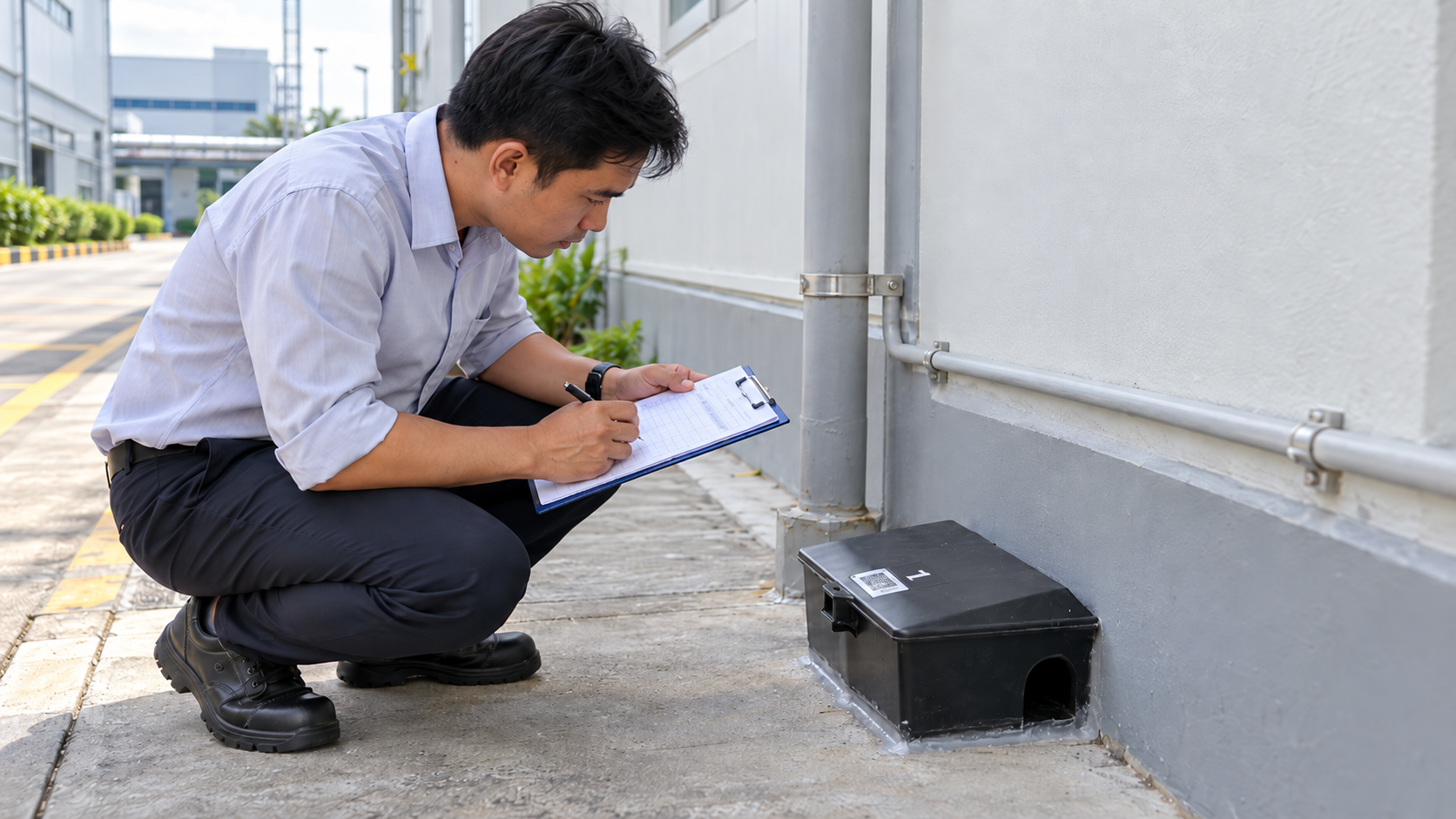
Each control point should have a clear identification code. This code helps technicians inspect the correct location across multiple service cycles and allows QA teams to retrieve data when needed.
One readily visible issue is an identification label that has peeled off, faded, gone missing or been changed after the device was relocated. Another example is a control station labelled A12 while the report records data under A21, breaking the clear link between the documentation and the actual site.
An auditor may randomly select a device and request the inspection history for that specific point. If the corresponding point cannot be identified on the map or in the report, the documentation will have difficulty demonstrating continuity of monitoring activities.
The facility should periodically check the condition of identification labels together with the devices themselves. The IDs shown on devices, maps and reports need to be consistent. When a device is relocated, replaced or removed, the related records also need to be updated at the same time.
3. Reports state only “inspected” but lack on-site evidence
A valuable pest control report helps the reader understand conditions at the time of inspection. Reports that repeatedly state only “normal”, “inspected” or “nothing detected” over a long period may not provide enough information to explain how the programme is being managed.
If QA teams are unsure which information fields should be required in a PCO report, they can refer to an approach for reading pest control reports based on pest density, trends, hotspots and corrective actions. A valuable report needs to help managers understand actual conditions and know what next step needs to be taken.
For points with abnormalities, the report should clearly show the location, type of sign, recorded level and on-site images where appropriate. For example, a finding of rodent droppings near a warehouse door needs to include the specific location and images that help QA understand exactly what was recorded.
Images also need to provide useful evidence for cross-checking. Images taken from too far away, images that do not clearly show the point being referenced, or the repeated use of the same image across multiple inspection cycles reduce the ability to demonstrate actual site conditions.
The purpose of the report is to help the responsible person answer the question: “What happened at this point?” When the information is sufficiently clear, QA can also more easily determine the next step to coordinate with maintenance, sanitation or operations.
4. Abnormal findings without clear corrective action
This issue directly affects how an auditor evaluates the facility’s ability to control risk. If a point records increased numbers of rodents, flies or insects but the documentation only records the counts, it does not yet show how the business responded.
For example, an insect light trap near a packaging area may record a sharp increase in insect numbers over two consecutive inspection cycles. The report needs to lead to further inspection, such as reviewing nearby doors, sources of light attraction, sanitation conditions or activities outside the area. This should then be followed by a specific action and an assigned person responsible for follow-up.
For rodents, if signs appear near a finished-goods warehouse, actions may include checking door gaps, reviewing routes along wall edges, inspecting nearby traps and assessing the external perimeter. The documentation needs to show that the issue has moved from detection to action. Addressing an abnormal finding does not necessarily mean applying more pesticides. Depending on the cause, the facility may need to repair door gaps, change sanitation practices, adjust devices or increase monitoring. This is the IPM approach: pest management based on prevention, monitoring and actual causes.
A corrective action should also have a clear status: completed, in progress or requiring further follow-up. Items that remain open for months without being closed or updated may raise questions during an audit.
5. Large amounts of data without clear trend analysis
A facility may have months of inspection data but still find it difficult to evaluate the programme if the figures remain isolated within individual reports. Auditors are often interested in whether the business can identify trends before an issue develops into an incident.
For example, an insect light trap may record 4 insects in the first month, 9 in the following month and 18 in the third month. Each individual figure may still be below the action threshold, but the data series already shows an upward trend that requires attention.
Similarly, multiple rodent findings along the same wall may indicate that an entry route is developing. If the data are reviewed point by point in isolation, this relationship can easily be overlooked.
Trend analysis helps QA answer important questions: which areas are showing increasing risk, which species are appearing more frequently, when the change began, and which causes need to be investigated. This provides a basis for deciding whether to increase monitoring frequency, change device locations or require infrastructure improvements.
When the data show an increase in pest density, QA needs to review the monitoring schedule and the risk level of each area. This is directly related to the question of how often a facility should carry out periodic insect control, because not every area needs to follow the same frequency.
6. Why are these five issues often easy to identify during an audit?
Auditors usually do more than review documentation at a desk. The assessment process may combine document review, random selection of points on the map, inspection of actual devices and requests to retrieve historical records.
It is this cross-checking process that makes inconsistencies easier to identify. A device with a missing ID, a trap that does not appear on the map, or an area with repeated findings but no follow-up action can all be identified quickly.
Therefore, a facility’s pest management documentation needs to be treated as a reflection of actual site conditions. The more closely the documentation reflects actual conditions, the easier the retrieval and explanation process becomes. If there are frequent inconsistencies between devices, maps and reports, the business should also review the management capability of its pest control provider. A suitable provider needs to meet PCO selection criteria relating to IPM capability, data transparency and audit support.
7. How should QA review pest management documentation before an audit?
QA should begin by randomly selecting several points on the map and checking them directly on site. Is the device still in the correct location? Is the ID still readable? Do actual conditions match the latest report? These simple questions can reveal many discrepancies.
Next, QA should select several points with previous abnormalities and trace their history. The records need to show how the issue developed, the actions taken and the results after treatment. If the documentation only records the finding without showing the next step, this is an area that needs to be completed.
Trend data should also be reviewed by pest group and by area. QA needs to understand which points are stable, which are showing signs of increase, and which items are awaiting coordination with other departments.
Finally, recent changes within the facility need to be reviewed, such as adding a warehouse, relocating a production line, adjusting receiving and dispatch areas, or changing the layout. These changes may make the existing map and previous risk assessment no longer appropriate.
For facilities preparing for an AIB assessment, the QA team should also cross-check the requirements of the version of the standard currently being applied. Businesses can review the pest management requirements in the AIB standard to prepare appropriate documentation and on-site inspections.
8. What questions should pest management documentation help answer?
Good pest management documentation needs to help QA and facility managers quickly answer the following questions: Where are the devices located. Which points have been inspected? Which areas have abnormalities. Are trends increasing or decreasing. What actions have been taken.
The documentation also needs to show the link between data and actual site conditions. A figure in a report needs to be linked to a specific location; an abnormality needs to lead to an action; and an action needs to have a result or follow-up status.
When these links are clear, pest management data can genuinely support risk management instead of becoming a collection of documents opened only before an audit.
9. How can the App and Dashboard help reduce documentation errors?
Managing dozens or hundreds of control points through multiple separate forms can make data difficult to cross-check. A digital system helps link information to each point, retain historical records and reduce the time required to retrieve information for review.
The PestMan App supports technicians in recording on-site data for each location. The PestMan Dashboard aggregates data by area and time period, helping QA identify trends more clearly.
Technology still needs to be combined with actual on-site inspection procedures. If a device has been relocated but the map has not been updated, the digital data will also fail to reflect actual site conditions accurately. Therefore, periodic cross-checking between the system and the actual facility layout remains very important.
10. Before an audit, do not only check whether the documentation is “complete”
A large volume of documentation does not necessarily make it easier for a facility to explain its programme if the information lacks clear links. An audit often reveals the quality of the system through its traceability and the ability to cross-check documentation against actual site conditions.
Businesses should focus on consistency: accurate maps – correct device IDs – reports with evidence – abnormalities followed by action – data showing trends. These five elements form a logical chain that helps responsible personnel understand the situation and know what needs to be done next.
Frequently Asked Questions
How often should the pest control map be updated?
The map should be reviewed periodically and updated whenever there are changes to the layout, device locations, entrances, warehouses, production lines or functional areas that may alter risk.
Is a device with a missing ID still a problem if it continues to function?
It can become a traceability issue. If it is not possible to determine which point on the map and report corresponds to the device, it will be difficult to demonstrate the inspection history for that point.
Must reports include images for every control point?
Images are particularly useful at points with abnormalities, damage or corrective actions that need verification. The extent to which images are used may depend on the management procedures of each facility.
Should trend data be monitored monthly or quarterly?
The review period should be appropriate to the inspection frequency and level of risk. Sensitive areas may require data to be reviewed over shorter intervals to detect changes early.
If pest density increases at a point but has not exceeded the action threshold, does it still need attention?
An increasing trend still needs to be reviewed. The business may increase inspections, review the cause or monitor the point more closely before the level of occurrence develops into an incident.
Good documentation must reflect how the facility is managing risk
Maps, device IDs, reports, corrective actions and trend data are directly connected. A small discrepancy in one area can make the entire traceability process more difficult when an auditor requests a deeper review.
Reviewing pest management documentation against actual site conditions helps facilities identify programme gaps early, while also enabling QA, HSE, maintenance, sanitation and the pest control provider to coordinate more clearly before and after each assessment.
If businesses are looking for a pest control company for businesses, need to survey the current pest situation or build a control program suitable for a factory, warehouse, hotel, or building, VFC PestMan can assist with on-site evaluation and propose solutions based on actual risks.
- Hotline: (+84) 932669883
- Email: contact@pestman.vn



Pheromone traps: An insect monitoring solution for pest control
Pheromone traps are applied in pest control due to their ability to attract...
Effective methods and processes for warehouse pest control
Kho hàng là nơi tập trung nguyên liệu, thành phẩm, bao bì, pallet và lượng…


Related news


Ready to eliminate audit risks and proactively protect customer experience & brand reputation?





Dear Valued Visitor,
To protect our clients' interests, all materials here are copyrighted and may not be reproduced without permission.
We appreciate your cooperation. Should you need to use our content professionally, please contact us directly.