





By pestman | 28-01-2026
A small pile of frass appearing at the base of a wall is not always a sign of termites. In many field inspection cases, the cause actually comes from carpenter ants (Carpenter Ants) – an ant species capable of excavating wood to build complex gallery systems inside structures.
What surprises many people is that carpenter ants do not eat wood. However, they can still cause significant damage to wooden structural components if the colony develops over a long period. If you spot large black ants frequently appearing at night or see frass accumulating near windows, door frames or roofs, it is time for an immediate inspection.
1. What are carpenter ants and why are they called “carpenter”?
Carpenter ants are a group of ants belonging to the genus Camponotus, one of the largest ant genera in the world. The name “carpenter” comes from their ability to excavating wood to create galleries and nesting chambers inside wooden materials.
Unlike termites, carpenter ants do not digest cellulose. They use wood as a safe shelter for the colony, especially in locations with high moisture levels or where the wood quality has degraded.
Currently, more than 1,000 species of Camponotus have been recorded globally. Some species adapt very well to urban environments and frequently appear in residential homes, hotels, offices or manufacturing facilities.
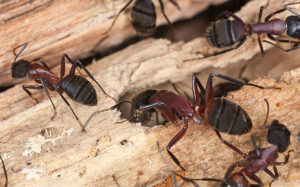
Carpenter ants
>> See more: Bullet ants - small insect with the most painful sting on Earth
2. Where do carpenter ants usually nest?
Carpenter ants (Camponotus) usually nest inside damp, decaying wood or wood damaged by fungi. In natural environments, they nest in dead tree stumps and rotting branches. When invading houses, they often hollow out and nest in soft or moist wooden areas:
- Moist areas: Along leaking water pipes, kitchen cabinets, or bathrooms.
- Wooden structures: Window frames, doorways, eaves, and wall voids.
- Out-of-sight places: Under flooring or in firewood piles stored near the house.
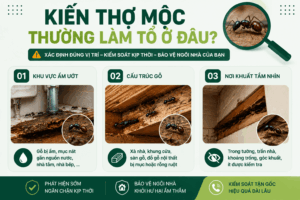
Where do carpenter ants usually nest?
2.1. Why are carpenter ants highly active at night?
Avoiding predators: Due to their large body size, carpenter ants are easily detected by daytime predators such as birds, lizards, and other large insects. Foraging in the dark helps them camouflage better and increases the survival rate of the entire colony.
Minimizing dehydration and maintaining moisture: Carpenter ants rely heavily on moist environments to survive. Sunlight and high daytime temperatures can cause their bodies to dehydrate rapidly. The cool air and high humidity at night create ideal conditions for them to leave the nest and forage without drying out.
Reducing food source competition: Many other ant and insect species are highly active during the day. Shifting to nocturnal activity helps carpenter ants monopolize food resources (such as honeydew from aphids, insect carcasses) without competing with other species.
2.2. When has the ant colony developed to a large scale?
The appearance of “flying ants” (winged ants): This is the clearest sign. Only when the colony reaches a large scale (at least 2,000 – 3,000 members) does the nest begin to produce about 200 – 400 winged reproductives (including males and young queens) in late summer or spring to swarm for mating and establish new colonies.
The formation of “satellite colonies”: When the parent colony (where the queen and eggs are located) becomes overcrowded, they expand their territory by establishing surrounding satellite colonies. Indoors, the parent colony is usually outdoors (in a damp tree stump) while the satellite colonies (containing workers and mature larvae) will be located in wall voids or damp wooden frames of the house.
The appearance of large workers (major workers): During the first 1-2 years, the colony consists mainly of minor workers. As the colony structure grows strong, they begin a clear caste differentiation and produce major workers with very large heads and bodies to protect the nest.
3. How to recognize a carpenter ant infestation indoors?
3.1. Appearance of small piles of sawdust (Frass)
The most obvious and common sign demonstrating the presence of carpenter ants is small piles of sawdust scattered on the floor. Unlike termites that consume wood for digestion, carpenter ants only excavate wood to create living spaces and galleries.
During the excavation process, they will push all the debris out through small openings in the wood grain. Upon close inspection, you will notice this sawdust is very coarse, looking like pencil shavings, often mixed with the carcasses of other insects or dried pupal casing fragments.
You should carefully inspect hidden areas such as the base of walls, kitchen cabinet corners, windowsills or directly beneath cracks in wooden paneling.
3.2. Hearing rustling sounds inside walls or woodwork
Since carpenter ants are highly nocturnal creatures, you can detect them through hearing when the surrounding environment is completely quiet. When you place your ear against drywall, wooden door frames or kitchen cabinetry after around 10 pm, you may hear consistent rustling or crackling sounds coming from within.
This distinctive sound is very similar to tissue paper or a plastic bag being gently crinkled. This is the resonant sound of thousands of ants continuously moving, scratching wood grains and cleaning the galleries inside your house structure.
3.3. Finding shed ant wings indoors
Discovering scattered pieces of shed ant wings is conclusive evidence that a large carpenter ant colony exists right inside or adjacent to your home. In spring or early summer, when mature colonies reach a large scale, they produce winged reproductives (including males and young queens) to swarm for mating.
After the mating process ends, the queens will break off their own wings to search for damp wood cavities to settle in and begin a new nesting cycle. If you happen to see many small, thin, and transparent insect wing fragments lying on windowsills, floors or near cracks, it means a major swarming event has just occurred.
3.4. Hollowed wood surfaces and the appearance of smooth exit holes
The gallery systems created by carpenter ants have very distinct morphological features that you can identify by sight and touch. When you use your fingers or a small hammer to tap gently along studs, door frames or wooden posts in the house, if you hear a hollow "thud" sound instead of a solid one, it is highly probable that the interior wood core has been severely damaged.
In addition, the exit holes created by this ant species on the wood surface are usually very clean, smooth, and absolutely never have mud or soil attached like termite nests.
3.5. Regular appearance of major workers
Carpenter ants are among the largest ant species in the world, with body lengths ranging from 0.6 to 1.3 cm and usually featuring a solid black or mixed red-and-black coloration. If you continuously encounter these large ants foraging alone on floors, kitchen countertops or sinks at night, it is not a coincidence.
The regular density of these large worker individuals is proof that the parent colony or their satellite colonies have rooted deeply into damp wall voids inside the house, rather than simply ants wandering in from the garden.
4. What is the most effective way to eradicate carpenter ants today?
4.1. Locating the exact position of the ant nest
Carpenter ants usually have a “parent colony” (where the queen resides in damp outdoor wood) and multiple “satellite colonies” indoors.
- Signs to identify: Look for small piles of wood powder (frass) pushed out under cracks, baseboards or wooden cabinets.
- Listening: Press your ear against walls or wood at night, you can hear a "scratching" sound as they excavate.
- Tracking: Place a small amount of sweet bait (honey or jam) to lure the ants, then follow the direction they carry the bait back to the nest.
4.2. The most effective extermination methods
Method 1: Using gel ant bait (most effective for satellite colonies)
Carpenter ants are highly sensitive. If contact sprays are used to kill them instantly, they will emit alarm pheromones and lock down the nest.
- How to do it: Use specialized ant baits such as Maxforce Quantum placed along the ant trails.
- Mechanism: Workers consume the bait, do not die immediately, but carry it back to the nest to share with the entire colony and the queen, helping to eradicate the nest entirely after 3–5 days.
Method 2: Specialized chemical dusts (eradicating the parent colony)
Once the nest entrance hole in the wall void or wooden beam is identified, you need to introduce the insecticide deep inside.
- Products: Use boric acid powder or chemical dusts containing deltamethrin.
- How to do it: Use a hand duster (or syringe) to inject the chemical dust directly deep into the voids and cracks containing the ant nest. The dust adheres to the ants' legs and bodies; when they groom themselves, they will ingest the toxin and die.
Method 3: Homemade boric acid bait (cost-effective)
If commercial products are unavailable, you can make your own slow-acting bait.
- Formula: Mix thoroughly 2/3 tablespoon of boric acid with 1/3 tablespoon of powdered sugar (or sweet jam).
- Placement: Place this mixture near areas where ants appear. Ants attracted by the sugar will consume it and carry the boric acid back, poisoning the digestive systems of the entire colony.
4.3. Preventing carpenter ants from returning
- Correcting moisture sources: Replace damp, rotting wood sections immediately because carpenter ants only nest in moist wooden areas.
- Sealing gaps: Use silicone caulk to seal cracks around windows, doors and the house foundation.
- Clearing vegetation around the house: Trim tree branches touching the roof or walls to cut off the ants' travel routes from vegetation into the house.
>> Learn more: Professional insect control services: Fast results and long-term safety


Mistakes that cause insects to recur in warehouses
Insects in warehouses can affect the quality of goods, efficiency, ...
Effective fly control in factories: Identifying the right species for root-cause treatment
In manufacturing environments, especially in food and beverage factories…
Related news

Ready to eliminate audit risks and proactively protect customer experience & brand reputation?






Dear Valued Visitor,
To protect our clients' interests, all materials here are copyrighted and may not be reproduced without permission.
We appreciate your cooperation. Should you need to use our content professionally, please contact us directly.