







 PART
01
By VFC PestMan | 31-08-2026
Comprehensive IPM pest control process for boarding schools
IPM for boarding schools is a pest management approach based on prevention, monitoring and control according to the risk level of each area. For schools with kitchens, dormitories and boarding facilities, an IPM programme connects multiple areas with different operating characteristics into one unified management system, helping detect risks early and select appropriate control measures.
Article content
1. What is IPM for boarding schools?
IPM stands for Integrated Pest Management. It is an approach that combines multiple preventive, monitoring and treatment measures to manage pests according to their causes and risk levels rather than focusing only on pests that are already present.
For educational environments, IPM is particularly important because boarding schools include many different types of spaces. Classrooms, boarding areas, kitchens, canteens, toilets, waste collection areas and outdoor landscaping each create different conditions for pest occurrence. Applying the same solution across the entire facility is unlikely to reflect the actual risks of each area.
A boarding-school IPM programme therefore needs to be built on an actual site survey. Data on pests, infrastructure, sanitation, environmental conditions and how each area is used are applied to identify risk points, establish monitoring systems and select appropriate control methods.
2. Why do boarding schools need IPM?

Boarding schools have high occupancy, particularly facilities that provide semi-boarding or full boarding. Learning, eating, resting and daily living activities take place continuously, making food, water, waste and people movement important factors to manage within the pest control programme.
Boarding areas also operate differently from classrooms. Students stay throughout the day, keep personal belongings, food and luggage, and continue daily activities into the evening. These factors may increase the risk of ants, cockroaches, rodents and other pest groups if sanitation and storage are not well managed.
IPM helps the school identify risks by area and focus resources where they are needed. Kitchens may prioritise flies, cockroaches and rodents; school grounds may focus more on mosquitoes and landscape-related risks; while boarding areas need particular attention to room sanitation, personal food and common-use areas.
3. How is IPM different from periodic insect spraying?
Spraying is one measure that may be used within a pest control programme, but long-term effectiveness depends on many other factors. If standing water remains, food continues to be spilled or structural gaps are not addressed, the environment will continue to support pest activity.
IPM focuses on managing these conditions first. The programme identifies where pests may enter, food and water sources, harbourage areas and activity trends through monitoring systems. When intervention is required, the method is selected according to the specific pest and area.
This approach is suitable for boarding schools because it helps reduce unnecessary treatment activities in areas frequently occupied by students and teachers. At the same time, the school has data to understand how programme effectiveness changes over time instead of evaluating it only by the number of spraying visits.
4. Which areas should a boarding-school IPM programme cover?
A comprehensive IPM programme needs to cover both the outdoor environment and areas inside buildings. Pest risks often begin at the perimeter before reaching sensitive areas, so zoning needs to reflect these possible entry routes.
The grounds, fences, vegetation, drains and waste collection areas form the outer control layer. Next are doors, corridors, receiving areas and connection points between the outside environment and buildings. The internal layer includes classrooms, functional rooms, kitchens, storage areas, boarding areas and other living spaces.
Dividing the facility into different risk levels helps the school determine appropriate monitoring frequency. Areas with food, water or continuous activity generally need closer monitoring than areas with more stable conditions.
To learn more specifically about the external protective layer, schools can refer to the article Pest control in school grounds.
5. What should be considered when controlling pests in school boarding areas?
Boarding areas often contain many small rooms and have high occupancy. Food brought into rooms, items stored for long periods, personal waste bins and shared toilets can create favourable conditions for ants, cockroaches and rodents if not properly managed.
One of the important aspects of boarding-school IPM is environmental control. Schools need rules for food storage, waste collection and room sanitation. Items that are rarely used should also be arranged to reduce concealed areas that are difficult to inspect.
Toilets, laundry rooms and water-related areas need to be monitored for moisture and drainage conditions. Persistent leaks may create harbourage conditions for cockroaches and other insect groups while making local treatment difficult to sustain. If small insects repeatedly appear around floor drains, toilets or laundry areas, the possibility of drain flies developing from organic matter and moisture inside the drainage system needs to be investigated.
A reporting system is also very important. Students or boarding staff need a quick way to report insects, rodent droppings or unusual signs so that the responsible team can inspect the issue before it spreads to multiple rooms.
6. What role does the kitchen play in a boarding-school IPM programme?
Semi-boarding and boarding-school kitchens are generally considered high-risk areas because they contain large amounts of food, water and organic matter. Therefore, the IPM programme needs to treat the kitchen as a specialised control area rather than applying the same process used for classrooms or corridors.
Control begins at the receiving stage. Food, cardboard boxes, pallets or transport vehicles can become routes for bringing pests into the facility from outside. Risks may then continue in storage, preparation, processing, washing and waste collection areas.
Monitoring traps and insect light traps help track conditions in appropriate areas. When data show increasing density, the cause needs to be investigated through sanitation, moisture, doors, drains and raw-material storage conditions.
Schools can learn more in the article Pest control in school kitchens before the new school year, which focuses specifically on kitchen preparation, deep cleaning and reviewing risk points before the start of term.
7. How can mosquitoes be controlled through an IPM programme?
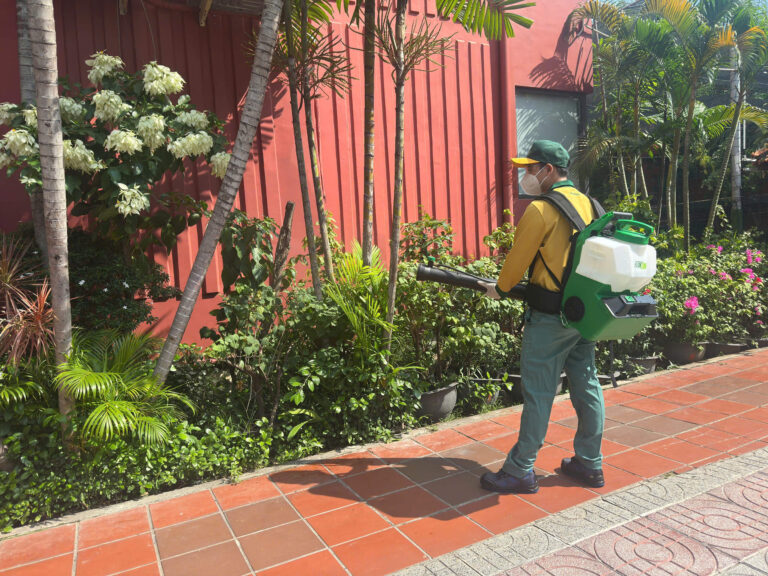
Mosquitoes in schools are closely associated with the outdoor environment. Planters, drainage channels, outdoor items and low-lying areas may retain water after rain, allowing mosquitoes to complete their life cycle.
IPM prioritises inspecting and removing breeding sites. Schools need to establish inspection routes after rainfall, especially in rarely visited or difficult-to-observe areas. Drainage systems also need to be maintained to reduce standing water.
Landscaping needs to be managed to reduce damp and overgrown areas. When monitoring shows increasing risk, professional treatment can be added based on the actual location, scope and level of activity.
This approach focuses on the source rather than relying on repeated treatment of adult mosquitoes. It is a typical example of the preventive thinking behind boarding-school IPM.
8. Rodent control in boarding schools
Rodents may reach educational facilities from drains, residential areas, vacant land, food businesses or environments outside the fence. Waste areas, kitchens and food stores can create strong attraction if food sources are not tightly managed.
The IPM programme needs to identify possible rodent movement routes. Fences, wall bases, gates, warehouse doors, pipes and receiving areas are locations that need to be surveyed for droppings, gnaw marks or other activity signs.
Physical exclusion measures play an important role in long-term control. Sealing gaps, managing doors, maintaining waste-area hygiene and reducing harbourage help limit rodent access to buildings.
Trap systems are used for monitoring and control in different areas. Data from these points help the school identify activity routes, evaluate effectiveness and adjust measures if rodent activity continues.
9. How does the monitoring system in boarding-school IPM work?

Monitoring helps the programme detect risks before pests become obvious incidents. Depending on the target pest, boarding schools may use crawling-insect traps, insect light traps, rodent monitoring systems or other suitable recording methods.
Each monitoring point needs to be identified and inspected according to plan. Data should include location, pest type, number or signs detected and relevant environmental changes. This helps create a history for each area.
Across multiple inspection cycles, data can be used for trend analysis. If cockroach numbers in one boarding area continue to rise or flying insects increase near a canteen entrance, the school has a basis for investigating the cause at an early stage. When there are many monitoring points, data can be digitised to track trends over time, identify hotspots and retrieve the history of each control point.
The value of the system therefore lies in supporting decisions. A trap that is placed but whose data are not tracked provides only limited value compared with a continuously managed monitoring system.
10. How should sanitation be managed in a boarding-school IPM programme?
Sanitation is one of the key foundations of an IPM programme. Pests require food, water and harbourage to survive, so managing these factors can reduce the attractiveness of the boarding-school environment.
In classrooms and boarding areas, food residues and beverages need to be removed promptly. Waste bins need to be used and collected according to schedule, especially in eating areas. Warehouses and storage rooms need to be arranged to allow inspection.
In kitchens, sanitation needs to cover difficult-to-access areas such as beneath and behind equipment, drains, washing areas and technical gaps. Outside, decaying leaves, organic matter and waste also need to be managed to reduce attractants.
The IPM programme is therefore directly connected to the work of sanitation staff. The PCO can detect issues and provide recommendations, while maintaining daily conditions requires cooperation from the school.
11. Managing infrastructure and entry routes
A clean facility can still experience pest activity if the building has many entry routes. Door gaps, windows, pipes, drains and wall penetrations can all become movement routes from outside to inside.
Infrastructure surveys help identify locations that need repair or sealing. For rodents, gaps beneath doors and technical routes are particularly important; for flying insects, door-opening activities and insect-screening systems need to be reviewed.
Infrastructure repairs also help reduce long-term control pressure. When the number of entry routes decreases, traps and treatment measures can focus on remaining risks instead of constantly responding to new pest entry.
IPM therefore requires participation from the maintenance department. Structural recommendations only create real results when they are converted into actions and followed up after completion.
12. When should boarding schools strengthen their IPM programme?
Before the new school year is a suitable time for a comprehensive review because many areas may have just gone through a period of reduced use. The facility can inspect drains, landscaping, classrooms, kitchens and boarding areas before occupancy rises again.
The rainy season also requires attention because standing water and moisture can change risks related to mosquitoes, cockroaches and other insect groups. Data from previous years can help identify areas where problems commonly occur during the same period.
Schools should also reassess the programme when new buildings are constructed, renovations are carried out, additional boarding areas are opened, or kitchen, waste and storage areas are changed. These changes may create new entry routes or attractants that were not included in the original assessment.
Repeated pest recurrence at the same location or continuously increasing monitoring data are also signals that adjustments are needed. Inspection frequency, device placement and control methods need to be reviewed based on the actual cause.
13. Boarding-school IPM implementation process
The first stage is site survey and risk assessment. The responsible provider needs to identify pest types, sources, entry routes and the sensitivity level of each area. These results are used to develop a Pest Risk Map for the entire facility.
Next, preventive measures and the monitoring system are established. Responsibilities for sanitation, landscaping, infrastructure and waste management need to be clearly assigned, while monitoring devices are positioned according to actual risk.
Data from inspections are recorded and analysed to identify trends. When an abnormal point appears, the cause is investigated and the treatment method is selected according to the target pest, risk level and characteristics of the area.
After treatment, results continue to be monitored. The cycle of assessment – prevention – monitoring – treatment – reassessment continues over time, allowing the IPM programme to adapt to changes in school operations.
14. Who needs to participate in a boarding-school IPM programme?
An IPM programme is unlikely to be effective if all responsibility is assigned to the pest control provider. Pest activity is directly influenced by how the facility is used and managed, so multiple departments need to participate.
School management is responsible for coordination and approval of necessary actions. Sanitation staff maintain hygiene conditions; kitchen teams manage food and waste; and maintenance personnel address structural, water and equipment issues.
Boarding staff also play an important role in monitoring rooms and communicating rules to students. Teachers, employees and facility users need to know how to report unusual signs so that information reaches the responsible team early.
The PCO provides professional expertise in identification, risk assessment, monitoring-system development and recommendations. When the parties coordinate, IPM becomes part of facility management rather than an independent treatment service. When selecting an external provider, schools should evaluate the PCO’s IPM implementation capability, data transparency and responsiveness rather than comparing only the number of spraying visits or the cost per treatment.
15. How does VFC PestMan develop IPM programmes for boarding schools?
Each educational facility has a different scale and operating environment. Preschools, general schools, international schools, universities and concentrated boarding facilities have different spatial structures, operating schedules and risk groups.
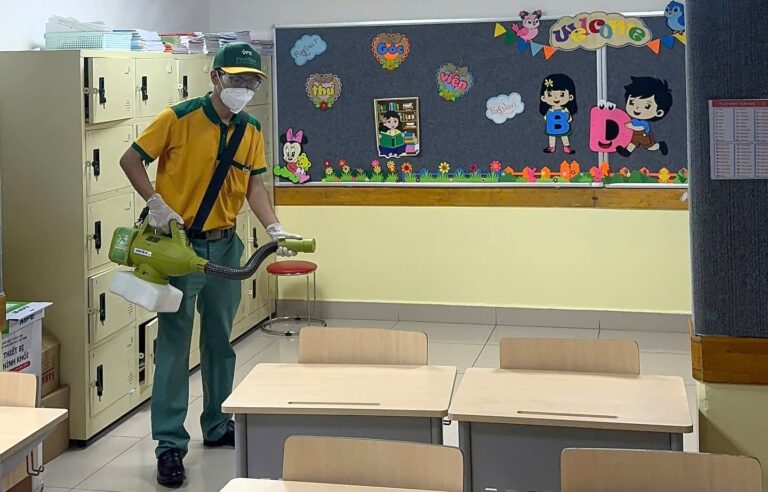
VFC PestMan implements IPM programmes beginning with a site survey and risk zoning. School grounds, kitchens, boarding areas, classrooms, toilets, waste areas and connection points between indoor and outdoor environments are considered within one unified system.
Based on survey results, prevention and monitoring measures are developed for each area. Periodic inspection data are used to identify trends, determine priority points and adjust the programme when operating conditions change.
This management approach helps boarding schools become more proactive in managing pest risks and reduces dependence on reactive treatment. At the same time, the data provide a basis for the school to evaluate programme effectiveness throughout the academic year.
16. From IPM to a comprehensive pest control programme for educational facilities
IPM is the core approach to pest management, but each area within a school still requires its own technical solution. Kitchens have food-related requirements, boarding areas focus on living environments, while school grounds require water management, landscaping control and management of pest entry from outside.
Therefore, the overall programme needs to connect all areas through multiple continuous layers of control. Data recorded at the perimeter can provide early warning of risks to internal areas, while incidents in kitchens or boarding areas can help trace sources back to the grounds or infrastructure.
For a broader understanding of pest groups, control areas and solutions across the entire educational facility, schools can refer to the article Pest and insect control for schools and educational facilities.
IPM for boarding schools helps educational facilities manage pests through prevention, monitoring and risk-based treatment. When school grounds, kitchens, classrooms and boarding areas are connected within the same programme, the school can identify risks earlier and select measures suited to each environment.
VFC PestMan is ready to support boarding schools in developing IPM programmes based on actual site surveys, risk zoning and periodic monitoring data. The objective is to maintain a safe learning and living environment, reduce conditions favourable to pests and improve management capability throughout the academic year.

Ready to eliminate audit risks and proactively protect customer experience & brand reputation?





Dear Valued Visitor,
To protect our clients' interests, all materials here are copyrighted and may not be reproduced without permission.
We appreciate your cooperation. Should you need to use our content professionally, please contact us directly.